Prove by mathematical induction that, for all positive integers \(n\),
\(1 + 2x + 3x^2 + \ldots + nx^{n-1} = \frac{1 - (n+1)x^n + nx^{n+1}}{(1-x)^2}.\)
Solution
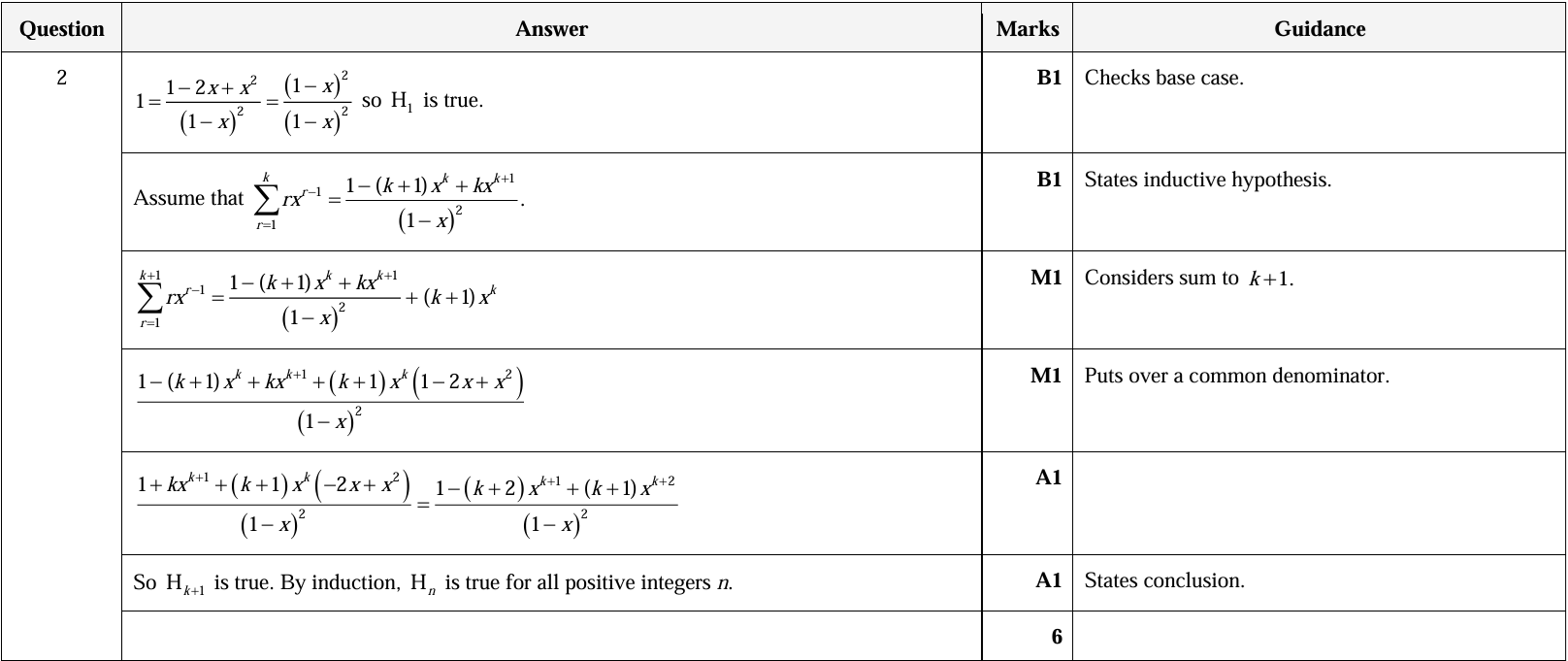
Base case: For \(n = 1\),
\(1 = \frac{1 - 2x + x^2}{(1-x)^2} = \frac{(1-x)^2}{(1-x)^2},\)
so \(H_1\) is true.
Inductive step: Assume that
\(\sum_{r=1}^{k} r x^{r-1} = \frac{1 - (k+1)x^k + kx^{k+1}}{(1-x)^2}.\)
Consider \(\sum_{r=1}^{k+1} r x^{r-1}\):
\(\sum_{r=1}^{k+1} r x^{r-1} = \frac{1 - (k+1)x^k + kx^{k+1}}{(1-x)^2} + (k+1)x^k.\)
Combine over a common denominator:
\(\frac{1 - (k+1)x^k + kx^{k+1} + (k+1)x^k(1-2x+x^2)}{(1-x)^2}.\)
Simplify:
\(\frac{1 + kx^{k+1} + (k+1)x^k(-2x + x^2)}{(1-x)^2} = \frac{1 - (k+2)x^{k+1} + (k+1)x^{k+2}}{(1-x)^2}.\)
Thus, \(H_{k+1}\) is true. By induction, \(H_n\) is true for all positive integers \(n\).
Log in to record attempts.