FM Nov 2023 p11 q01
4178
(a) By considering \((r+1)^2 - r^2\), use the method of differences to prove that
\(\sum_{r=1}^{n} r = \frac{1}{2} n(n+1).\)
(b) Given that \(\sum_{r=1}^{n} (r+a) = n\), find \(a\) in terms of \(n\).
Solution
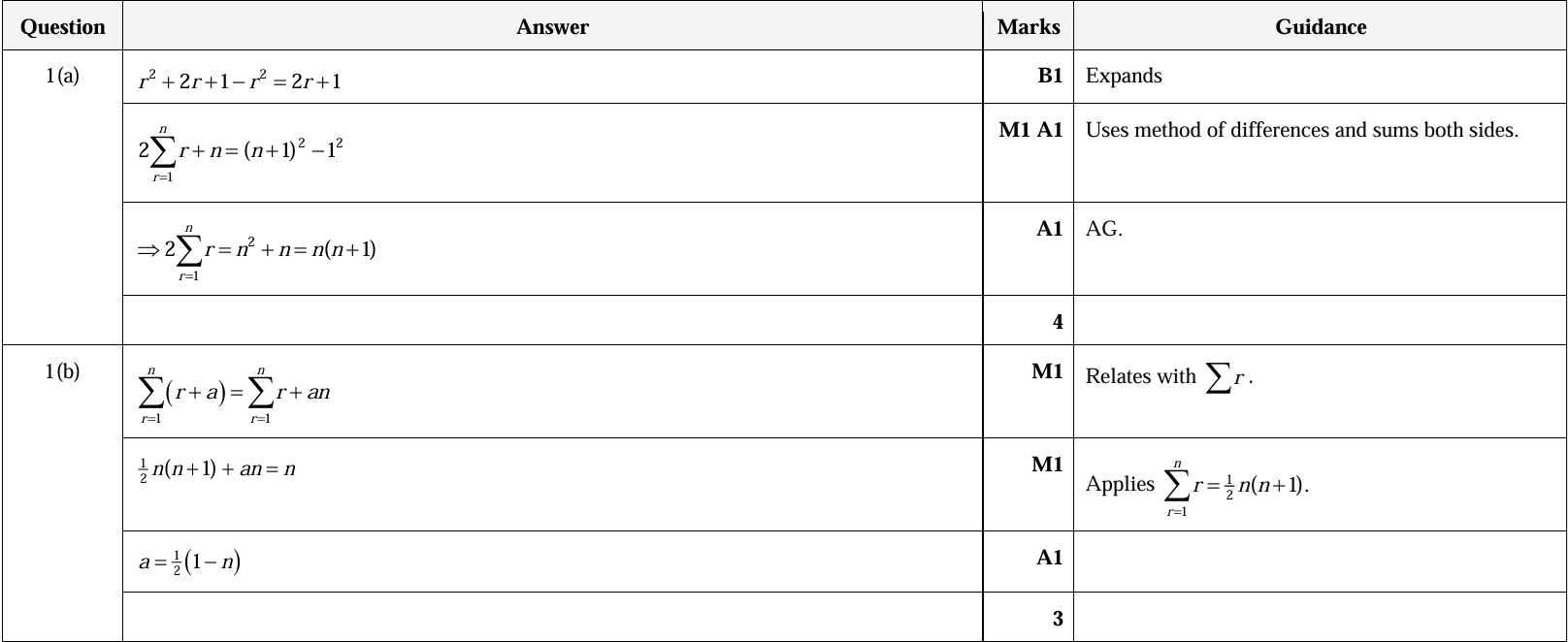
(a) Consider \((r+1)^2 - r^2 = r^2 + 2r + 1 - r^2 = 2r + 1\).
Using the method of differences, sum both sides:
\(2 \sum_{r=1}^{n} r + n = (n+1)^2 - 1^2\)
\(\Rightarrow 2 \sum_{r=1}^{n} r = n^2 + n(n+1)\)
Thus, \(\sum_{r=1}^{n} r = \frac{1}{2} n(n+1)\).
(b) \(\sum_{r=1}^{n} (r+a) = \sum_{r=1}^{n} r + an\)
\(\frac{1}{2} n(n+1) + an = n\)
Solving for \(a\):
\(a = \frac{1}{2}(1-n)\)
Log in to record attempts.