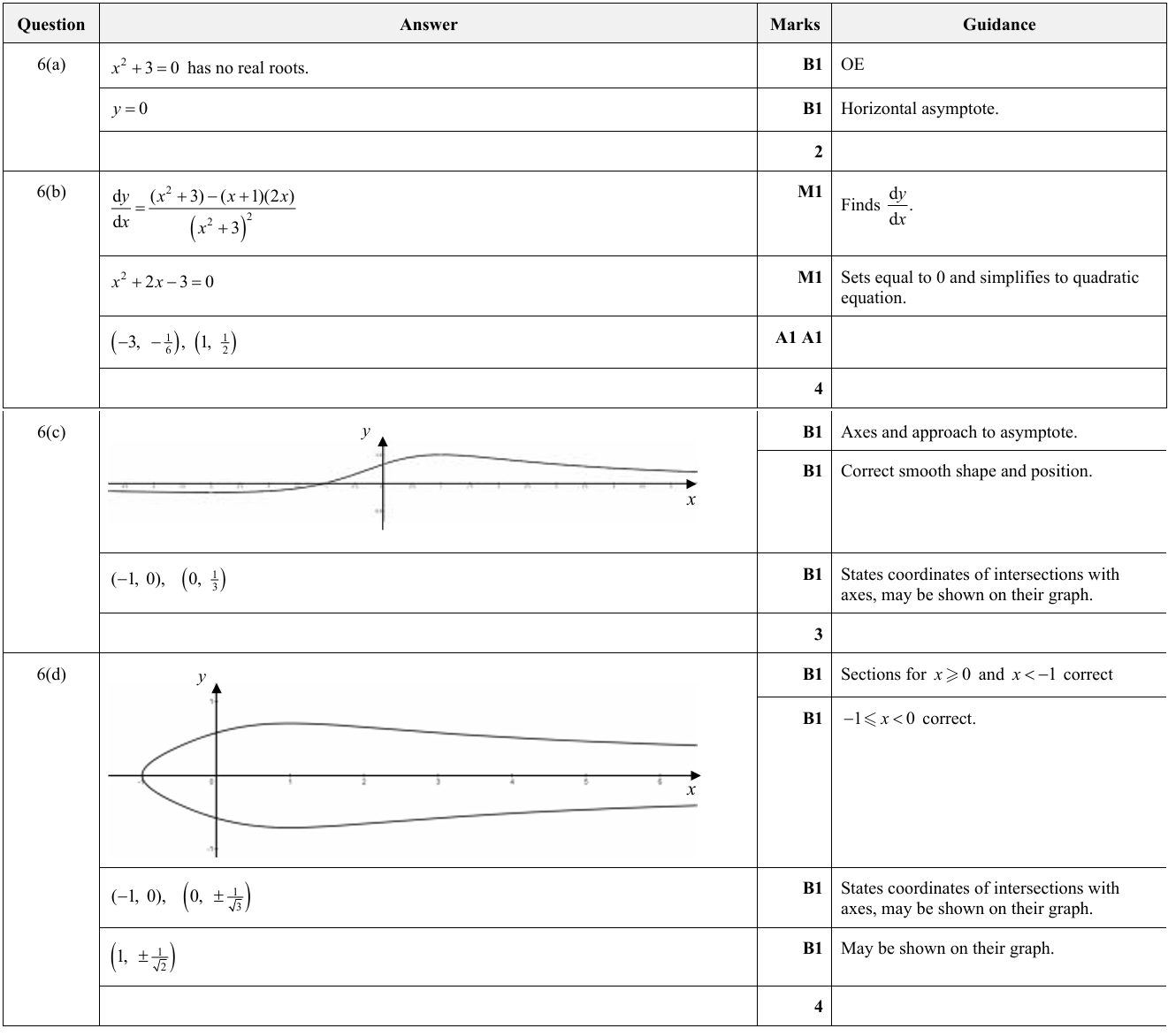
(a) To find vertical asymptotes, set the denominator equal to zero: \(x^2 + 3 = 0\). This equation has no real roots, so there are no vertical asymptotes. The horizontal asymptote is found by considering the limit as \(x\) approaches infinity: \(y = \frac{x+1}{x^2+3} \to 0\). Thus, the horizontal asymptote is \(y = 0\).
(b) To find stationary points, differentiate \(y\) with respect to \(x\): \(\frac{dy}{dx} = \frac{(x^2+3) - (x+1)(2x)}{(x^2+3)^2}\). Set \(\frac{dy}{dx} = 0\) to find \(x^2 + 2x - 3 = 0\). Solving this quadratic equation gives \(x = -3\) and \(x = 1\). Substituting back into the original equation gives the stationary points \((-3, -\frac{1}{6})\) and \((1, \frac{1}{2})\).
(c) The intersections with the axes occur when \(y = 0\) and \(x = 0\). For \(y = 0\), solve \(x+1 = 0\) to get \(x = -1\), so the intersection is \((-1, 0)\). For \(x = 0\), \(y = \frac{1}{3}\), so the intersection is \((0, \frac{1}{3})\).
(d) For \(y^2 = \frac{x+1}{x^2+3}\), the intersections with the axes are the same as in part (c), but \(y\) can be positive or negative. Thus, the intersections are \((-1, 0)\) and \((0, \pm \frac{1}{3})\). The stationary points are \((1, \pm \frac{1}{2})\).