9231 P12 - Jun 2024 - Q03 - 8 marks
4166
(a) Use standard results from the list of formulae (MF19) to show that
\(\sum_{r=1}^{N} r(r+1)(3r+4) = \frac{1}{12}N(N+1)(N+2)(9N+19).\)
(b) Express \(\frac{3r+4}{r(r+1)}\) in partial fractions and hence use the method of differences to find
\(\sum_{r=1}^{N} \frac{3r+4}{r(r+1)} \left( \frac{1}{4} \right)^{r+1}\)
in terms of \(N\).
(c) Deduce the value of
\(\sum_{r=1}^{\infty} \frac{3r+4}{r(r+1)} \left( \frac{1}{4} \right)^{r+1}.\)
Solution
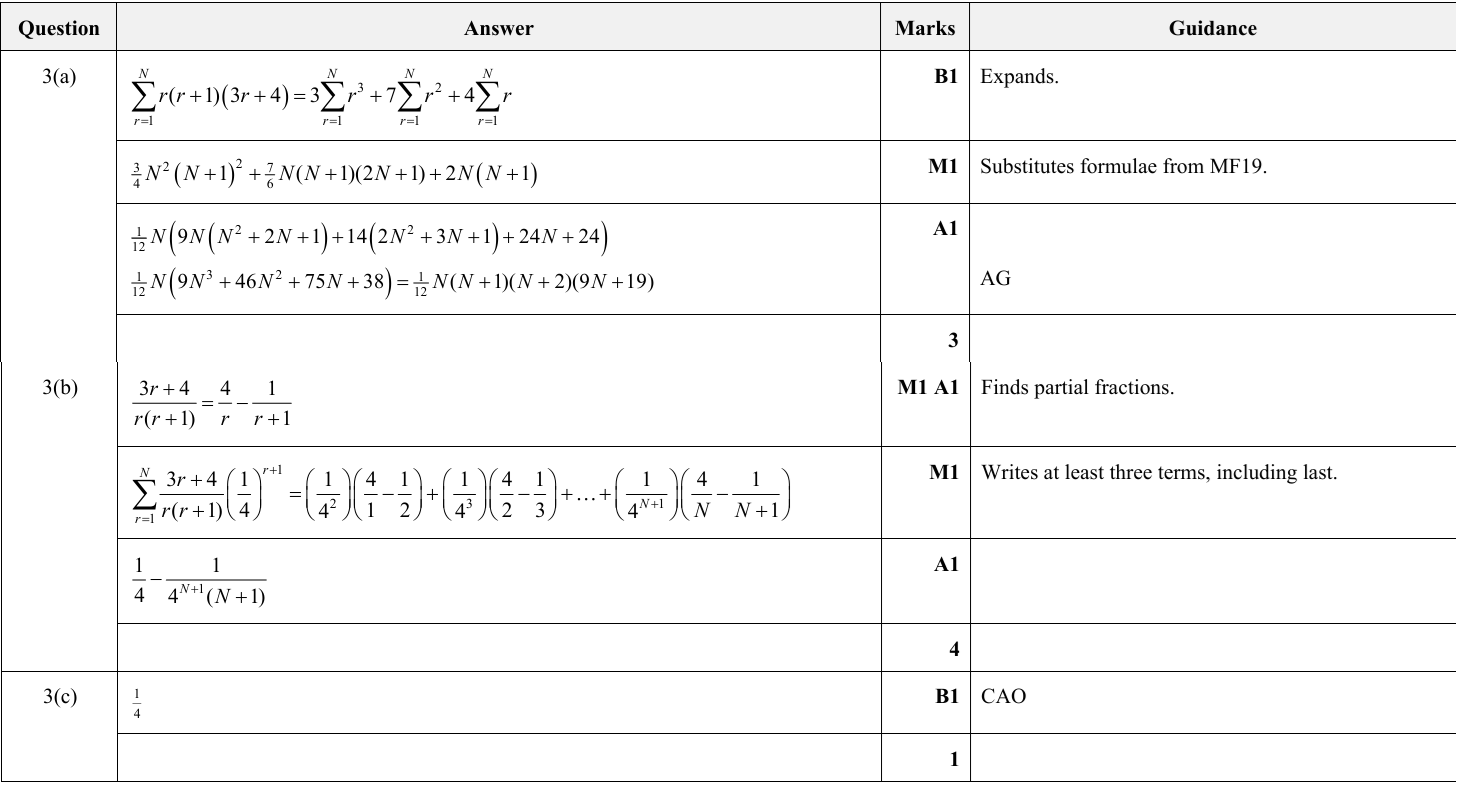
(a) Expand the expression \(\sum_{r=1}^{N} r(r+1)(3r+4)\) as follows:
\(3 \sum_{r=1}^{N} r^3 + 7 \sum_{r=1}^{N} r^2 + 4 \sum_{r=1}^{N} r.\)
Using standard formulae:
\(\frac{3}{4} N^2 (N+1)^2 + \frac{7}{6} N(N+1)(2N+1) + 2N(N+1).\)
Simplify to:
\(\frac{1}{12} N (9N^3 + 46N^2 + 75N + 38) = \frac{1}{12} N(N+1)(N+2)(9N+19).\)
(b) Express \(\frac{3r+4}{r(r+1)}\) in partial fractions:
\(\frac{3r+4}{r(r+1)} = \frac{4}{r} - \frac{1}{r+1}.\)
Then,
\(\sum_{r=1}^{N} \frac{3r+4}{r(r+1)} \left( \frac{1}{4} \right)^{r+1} = \left( \frac{1}{4^2} \right) \left( 4 - 1 \right) + \left( \frac{1}{4^3} \right) \left( 4 - \frac{1}{2} \right) + \ldots + \left( \frac{1}{4^{N+1}} \right) \left( 4 - \frac{1}{N+1} \right).\)
This simplifies to:
\(\frac{1}{4} - \frac{1}{4^{N+1}(N+1)}.\)
(c) As \(N \to \infty\), the term \(\frac{1}{4^{N+1}(N+1)} \to 0\), so the sum converges to:
\(\frac{1}{4}\).