FM Nov 2024 p13 q02
4151
Prove by mathematical induction that, for all positive integers n,
\(\frac{d^n}{dx^n} \left( \arctan x \right) = P_n(x) (1 + x^2)^{-n},\)
where \(P_n(x)\) is a polynomial of degree \(n - 1\).
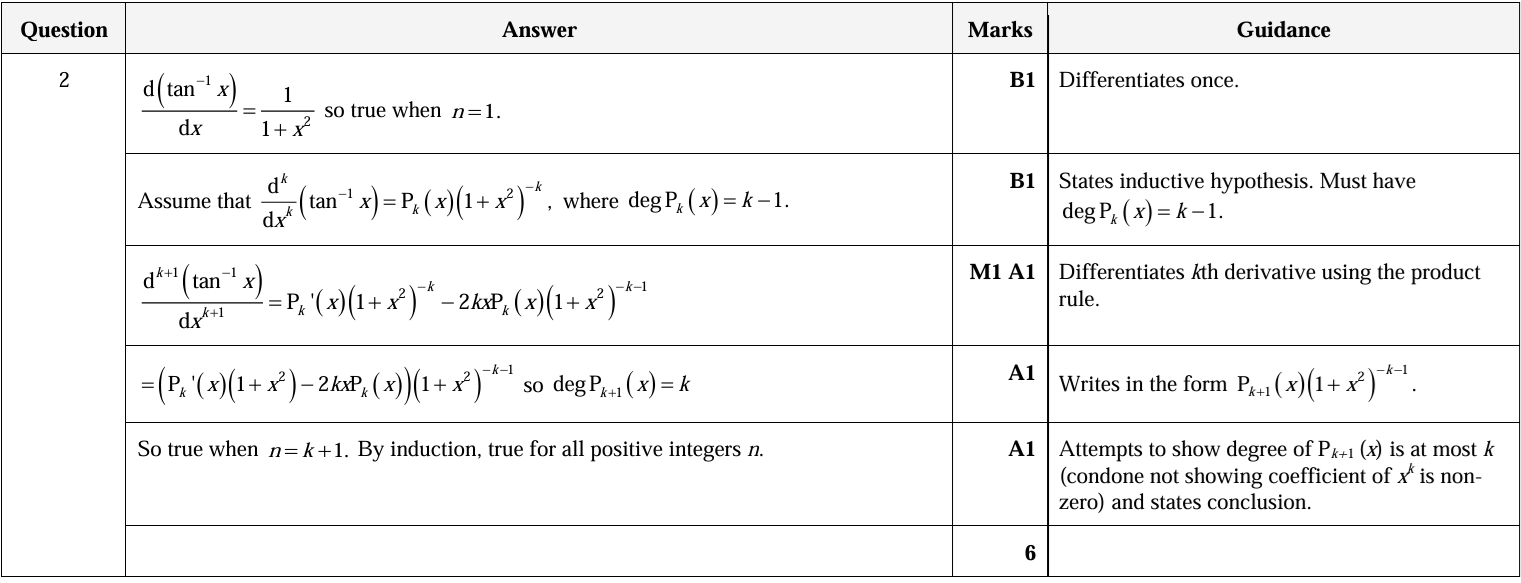
Solution
Base case: For \(n = 1\),
\(\frac{d}{dx} \left( \arctan x \right) = \frac{1}{1 + x^2},\)
which is true.
Inductive step: Assume
\(\frac{d^k}{dx^k} \left( \arctan x \right) = P_k(x) (1 + x^2)^{-k},\)
where \(\deg P_k(x) = k - 1\).
Then,
\(\frac{d^{k+1}}{dx^{k+1}} \left( \arctan x \right) = P_k'(x) (1 + x^2)^{-k} - 2kx P_k(x) (1 + x^2)^{-k-1}.\)
This can be written as
\(\left( P_k'(x) (1 + x^2) - 2kx P_k(x) \right) (1 + x^2)^{-k-1},\)
so \(\deg P_{k+1}(x) = k\).
Thus, true for \(n = k + 1\). By induction, true for all positive integers \(n\).
Log in to record attempts.