9231 P12 - Nov 2024 - Q05 - 9 marks
4147
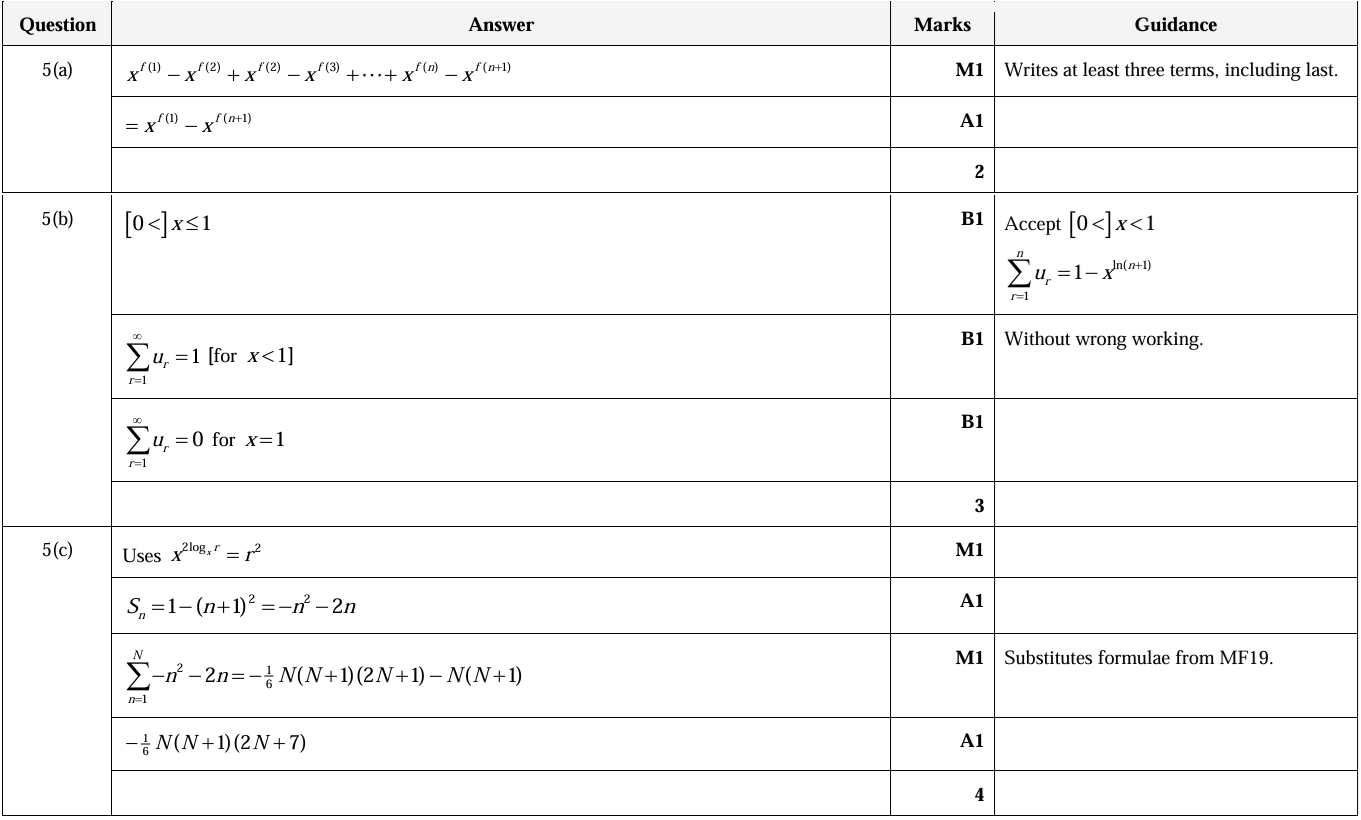
It is given that \(S_n = \sum_{r=1}^{n} u_r\), where \(u_r = x^{f(r)} - x^{f(r+1)}\) and \(x > 0\).
(a) Find \(S_n\) in terms of \(n, x\) and the function \(f\).
(b) Given that \(f(r) = \ln r\), find the set of values of \(x\) for which the infinite series \(u_1 + u_2 + u_3 + \ldots\) is convergent and give the sum to infinity when this exists.
(c) Given instead that \(f(r) = 2 \log_x r\) where \(x \neq 1\), use standard results from the List of formulae (MF19) to find \(\sum_{n=1}^{N} S_n\) in terms of \(N\). Fully factorise your answer.