Browsing as Guest. Progress, bookmarks and attempts are disabled.
Log in to track your work.
June 2004 p4 q1
4087
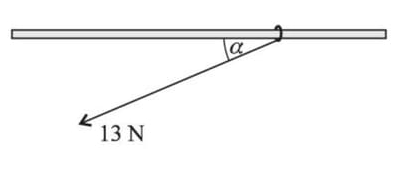
A ring of mass 1.1 kg is threaded on a fixed rough horizontal rod. A light string is attached to the ring and the string is pulled with a force of magnitude 13 N at an angle \(\alpha\) below the horizontal, where \(\tan \alpha = \frac{5}{12}\) (see diagram). The ring is in equilibrium.
(i) Find the frictional component of the contact force on the ring.
(ii) Find the normal component of the contact force on the ring.
(iii) Given that the equilibrium of the ring is limiting, find the coefficient of friction between the ring and the rod.
Solution
To solve the problem, we need to resolve the forces acting on the ring.
(i) The frictional component of the contact force is the horizontal component of the tension in the string. Given \(\tan \alpha = \frac{5}{12}\), we can find \(\cos \alpha\) using the identity \(\cos \alpha = \frac{12}{13}\). Thus, the frictional force \(F = 13 \cos \alpha = 13 \times \frac{12}{13} = 12 \text{ N}\).
(ii) The normal component of the contact force is the sum of the vertical component of the tension and the weight of the ring. The vertical component of the tension is \(13 \sin \alpha\), where \(\sin \alpha = \frac{5}{13}\). Therefore, the normal force \(R = 1.1 \times 10 + 13 \sin \alpha = 11 + 13 \times \frac{5}{13} = 16 \text{ N}\).
(iii) In limiting equilibrium, the frictional force is equal to the product of the coefficient of friction \(\mu\) and the normal force \(R\). Thus, \(\mu = \frac{F}{R} = \frac{12}{16} = 0.75\).