9709 P43 - Nov 2015 - Q2
4084
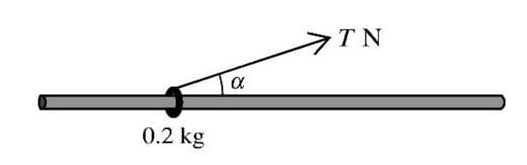
A ring of mass 0.2 kg is threaded on a fixed rough horizontal rod and a light inextensible string is attached to the ring at an angle \(\alpha\) above the horizontal, where \(\cos \alpha = 0.96\). The ring is in limiting equilibrium with the tension in the string \(T\) N (see diagram). Given that the coefficient of friction between the ring and the rod is 0.25, find the value of \(T\).
Solutions locked. Please sign in with access to view them.