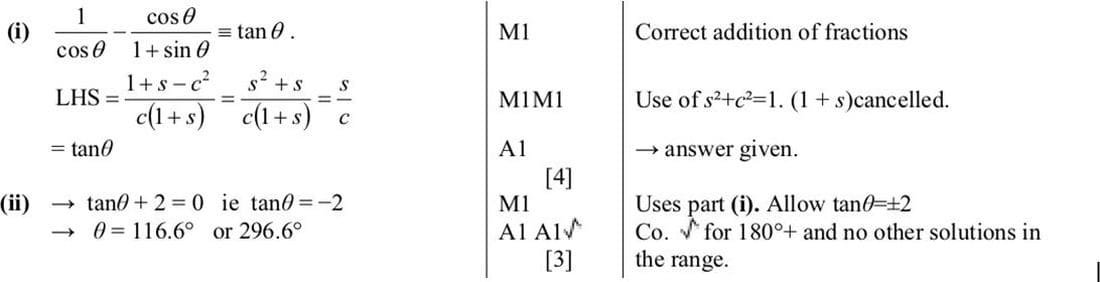
(i) Start with the left-hand side (LHS):
\(\frac{1}{\cos \theta} - \frac{\cos \theta}{1 + \sin \theta}\)
Combine the fractions:
\(\frac{1 + \sin \theta - \cos^2 \theta}{\cos \theta (1 + \sin \theta)}\)
Using the identity \(\sin^2 \theta + \cos^2 \theta = 1\), replace \(1 - \cos^2 \theta\) with \(\sin^2 \theta\):
\(\frac{\sin^2 \theta + \sin \theta}{\cos \theta (1 + \sin \theta)}\)
Factor out \(\sin \theta\):
\(\frac{\sin \theta (\sin \theta + 1)}{\cos \theta (1 + \sin \theta)}\)
Cancel \(1 + \sin \theta\):
\(\frac{\sin \theta}{\cos \theta} = \tan \theta\)
Thus, the identity is proven.
(ii) Solve the equation:
\(\frac{1}{\cos \theta} - \frac{\cos \theta}{1 + \sin \theta} + 2 = 0\)
Using part (i), replace the expression with \(\tan \theta\):
\(\tan \theta + 2 = 0\)
\(\tan \theta = -2\)
Find \(\theta\) such that \(\tan \theta = -2\) in the range \(0^\circ \leq \theta \leq 360^\circ\):
\(\theta = 116.6^\circ\) or \(296.6^\circ\)