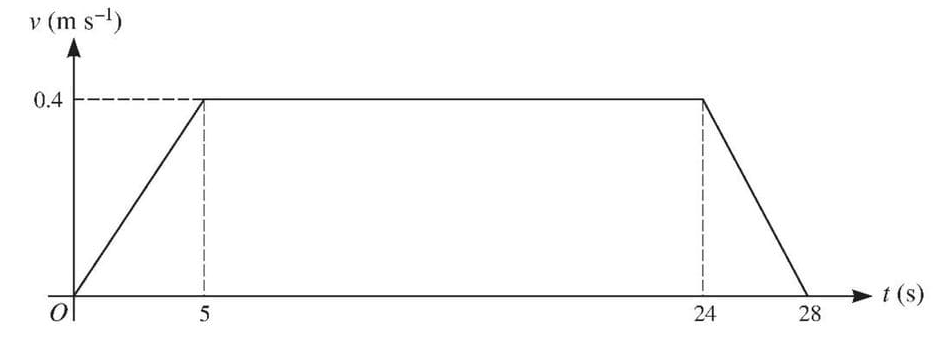
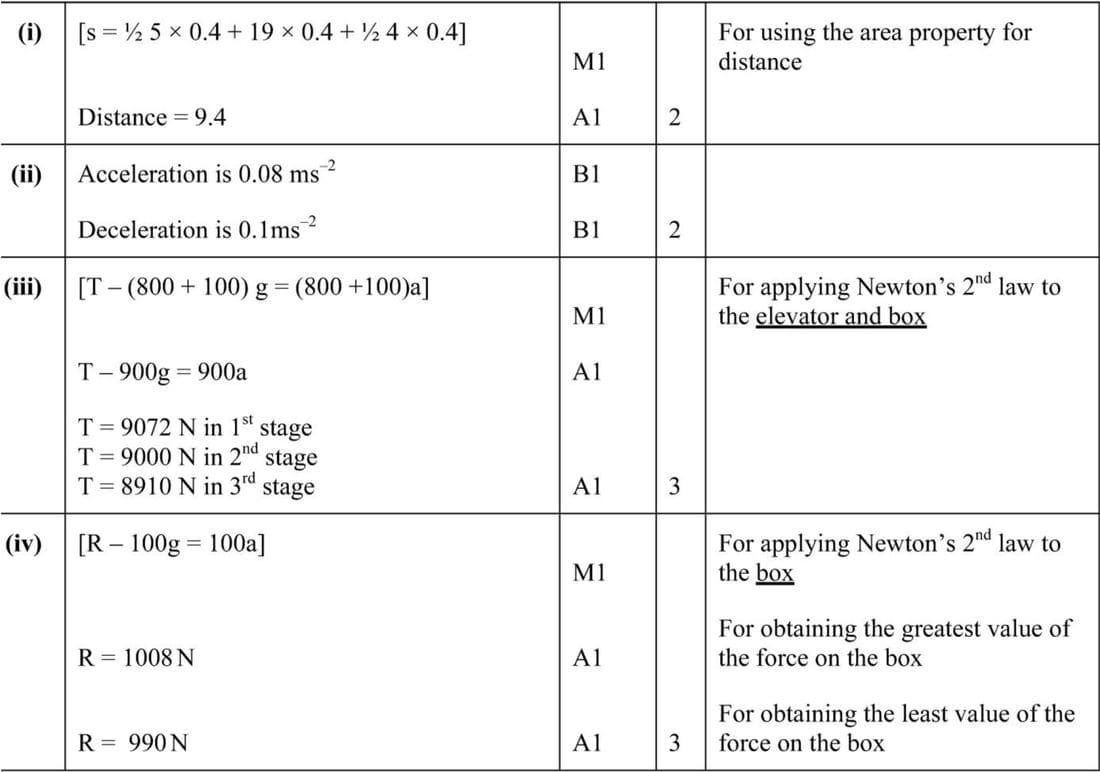
(i) The distance travelled by the elevator is the area under the velocity-time graph. The graph consists of a trapezium with a base of 24 s and a height of 0.4 m/s. The area is calculated as:
\(s = \frac{1}{2} \times 5 \times 0.4 + 19 \times 0.4 + \frac{1}{2} \times 4 \times 0.4 = 9.4 \text{ m}\)
(ii) The acceleration during the first stage is the slope of the line from 0 to 5 s:
\(a = \frac{0.4}{5} = 0.08 \text{ m/s}^2\)
The deceleration during the third stage is the slope of the line from 24 to 28 s:
\(a = \frac{0.4}{4} = 0.1 \text{ m/s}^2\)
(iii) Using Newton's second law for the elevator and box system:
\(T - (800 + 100)g = (800 + 100)a\)
\(T - 900g = 900a\)
For the first stage, \(a = 0.08 \text{ m/s}^2\):
\(T = 900 \times 9.8 + 900 \times 0.08 = 9072 \text{ N}\)
For the second stage, \(a = 0\):
\(T = 900 \times 9.8 = 9000 \text{ N}\)
For the third stage, \(a = -0.1 \text{ m/s}^2\):
\(T = 900 \times 9.8 - 900 \times 0.1 = 8910 \text{ N}\)
(iv) For the force on the box, using \(R - 100g = 100a\):
Greatest force (first stage):
\(R = 100 \times 9.8 + 100 \times 0.08 = 1008 \text{ N}\)
Least force (third stage):
\(R = 100 \times 9.8 - 100 \times 0.1 = 990 \text{ N}\)