9709 P4 - Jun 2006 - Q7
4063
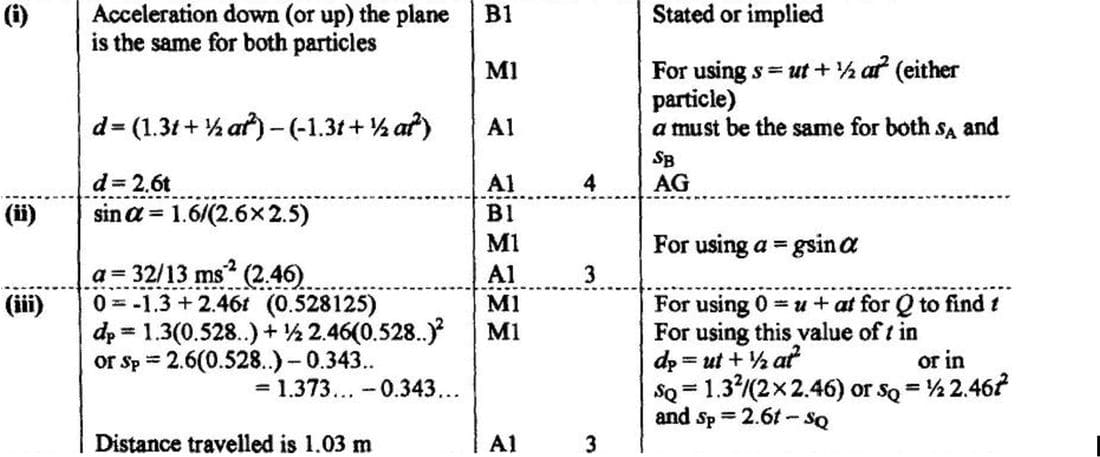
Two particles P and Q move on a line of greatest slope of a smooth inclined plane. The particles start at the same instant and from the same point, each with speed 1.3 m s-1. Initially P moves down the plane and Q moves up the plane. The distance between the particles t seconds after they start to move is d m.
- Show that d = 2.6t.
\(When t = 2.5 the difference in the vertical height of the particles is 1.6 m. Find\)
- the acceleration of the particles down the plane,
- the distance travelled by P when Q is at its highest point.