9709 P42 - Nov 2020 - Q6
4053
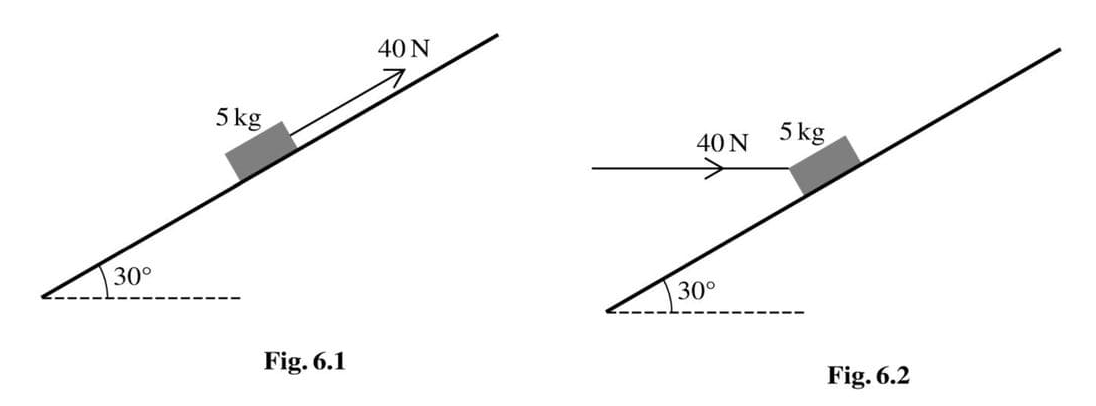
A block of mass 5 kg is placed on a plane inclined at 30° to the horizontal. The coefficient of friction between the block and the plane is \(\mu\).
(a) When a force of magnitude 40 N is applied to the block, acting up the plane parallel to a line of greatest slope, the block begins to slide up the plane (see Fig. 6.1). Show that \(\mu < \frac{1}{5} \sqrt{3}\).
(b) When a force of magnitude 40 N is applied horizontally, in a vertical plane containing a line of greatest slope, the block does not move (see Fig. 6.2). Show that, correct to 3 decimal places, the least possible value of \(\mu\) is 0.152.
Solutions locked. Please sign in with access to view them.