9709 P42 - Nov 2014 - Q6
4051
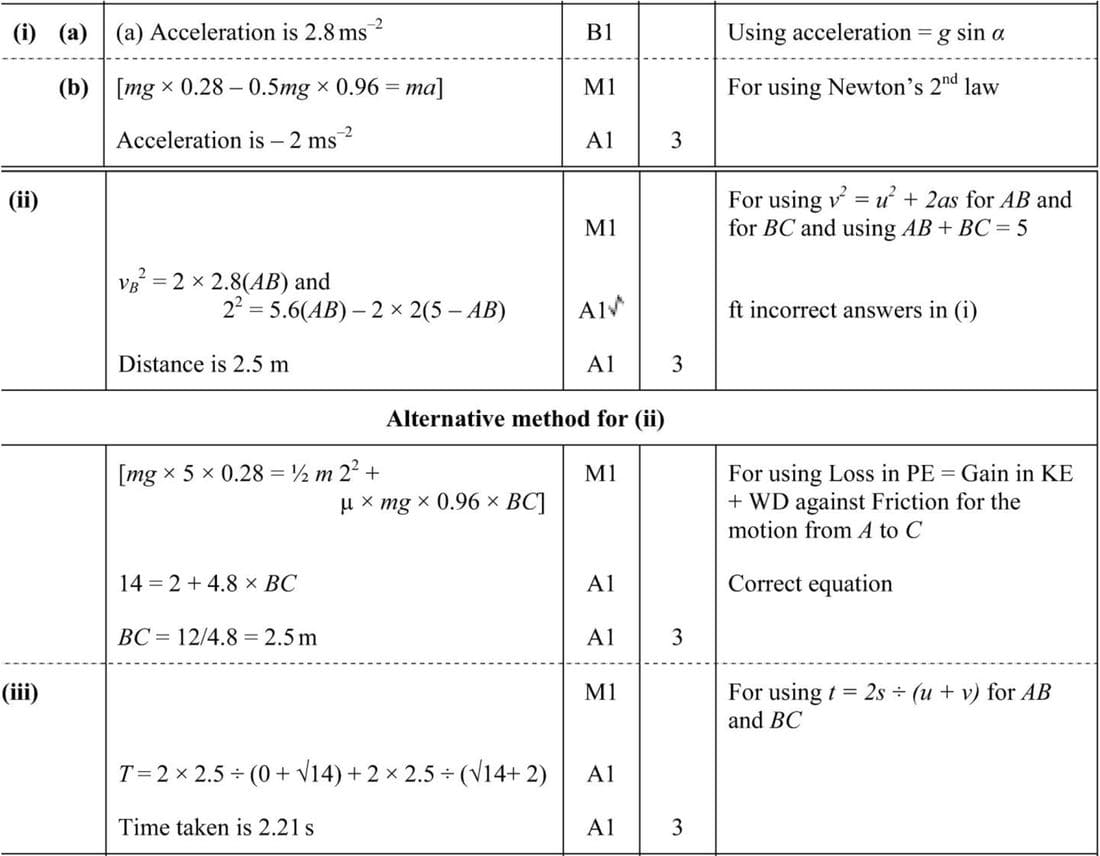
ABC is a line of greatest slope of a plane inclined at angle \(\alpha\) to the horizontal, where \(\sin \alpha = 0.28\) and \(\cos \alpha = 0.96\). The point A is at the top of the plane, the point C is at the bottom of the plane and the length of AC is 5 m. The part of the plane above the level of B is smooth and the part below the level of B is rough. A particle P is released from rest at A and reaches C with a speed of 2 m s-1. The coefficient of friction between P and the part of the plane below B is 0.5. Find
- the acceleration of P while moving
- from A to B,
- from B to C.
- the distance AB,
- the time taken for P to move from A to C.