Browsing as Guest. Progress, bookmarks and attempts are disabled.
Log in to track your work.
Nov 2009 p42 q4
4028
A particle moves up a line of greatest slope of a rough plane inclined at an angle \(\alpha\) to the horizontal, where \(\cos \alpha = 0.96\) and \(\sin \alpha = 0.28\).
Given that the normal component of the contact force acting on the particle has magnitude 1.2 N, find the mass of the particle.
Given also that the frictional component of the contact force acting on the particle has magnitude 0.4 N, find the deceleration of the particle.
The particle comes to rest on reaching the point \(X\).
Determine whether the particle remains at \(X\) or whether it starts to move down the plane.
Solution
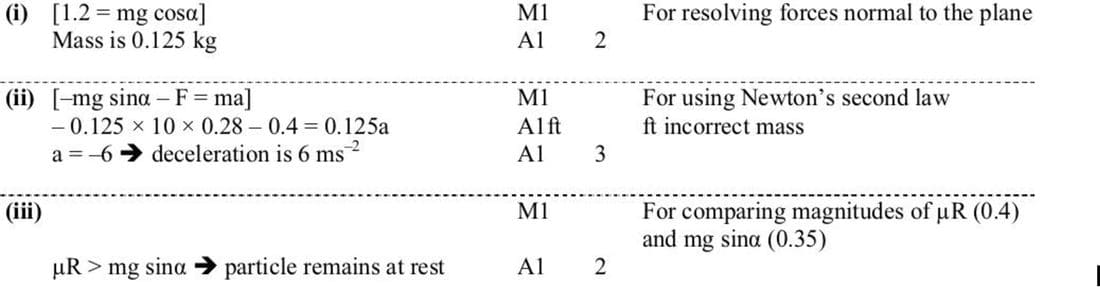
(i) Resolve the forces normal to the plane: \(R = mg \cos \alpha\).
Given \(R = 1.2\) N and \(\cos \alpha = 0.96\), we have:
\(1.2 = mg \times 0.96\)
\(mg = \frac{1.2}{0.96} = 1.25\)
\(m = \frac{1.25}{10} = 0.125\) kg
(ii) Use Newton's second law along the plane:
\(-mg \sin \alpha - F = ma\)
\(-0.125 \times 10 \times 0.28 - 0.4 = 0.125a\)
\(-0.35 - 0.4 = 0.125a\)
\(a = -6\)
Deceleration is 6 m/s2
(iii) Compare magnitudes of \(\mu R\) and \(mg \sin \alpha\):
\(\mu R = 0.4\) and \(mg \sin \alpha = 0.35\)
Since \(\mu R > mg \sin \alpha\), the particle remains at rest.