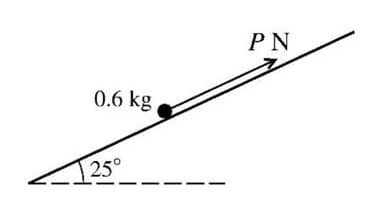
To find the set of possible values of \(P\), we need to consider the forces acting on the particle and the conditions for equilibrium.
1. Resolve forces parallel to the plane:
\(P = \pm F + 0.6g \sin 25^{\circ}\)
where \(F\) is the frictional force.
2. The maximum frictional force \(F\) is given by:
\(F = \mu R\)
where \(R\) is the normal reaction force.
3. Resolve forces perpendicular to the plane to find \(R\):
\(R = 0.6g \cos 25^{\circ}\)
4. Substitute \(R\) into the friction formula:
\(F = 0.36 \times 0.6g \cos 25^{\circ}\)
5. Calculate \(P_{\text{max}}\) and \(P_{\text{min}}\):
\(P_{\text{max}} = F + 0.6g \sin 25^{\circ}\)
\(P_{\text{min}} = -F + 0.6g \sin 25^{\circ}\)
6. Substitute the values to find \(P_{\text{max}}\) and \(P_{\text{min}}\):
\(P_{\text{max}} = 0.36 \times 0.6g \cos 25^{\circ} + 0.6g \sin 25^{\circ}\)
\(P_{\text{min}} = -0.36 \times 0.6g \cos 25^{\circ} + 0.6g \sin 25^{\circ}\)
7. Calculate the numerical values:
\(P_{\text{max}} = 4.49\)
\(P_{\text{min}} = 0.578\)
Therefore, the set of possible values for \(P\) is \(\{ P : 0.578 \leq P \leq 4.49 \}\).