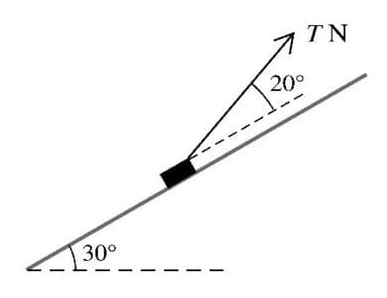
To solve this problem, we need to resolve the forces acting on the block both perpendicular and parallel to the inclined plane.
Step 1: Resolve forces perpendicular to the plane.
The normal reaction force \(R\) and the component of the tension \(T \sin 20^{\circ}\) act perpendicular to the plane. The weight component \(2.5g \cos 30^{\circ}\) acts perpendicular to the plane as well.
Thus, the equation is:
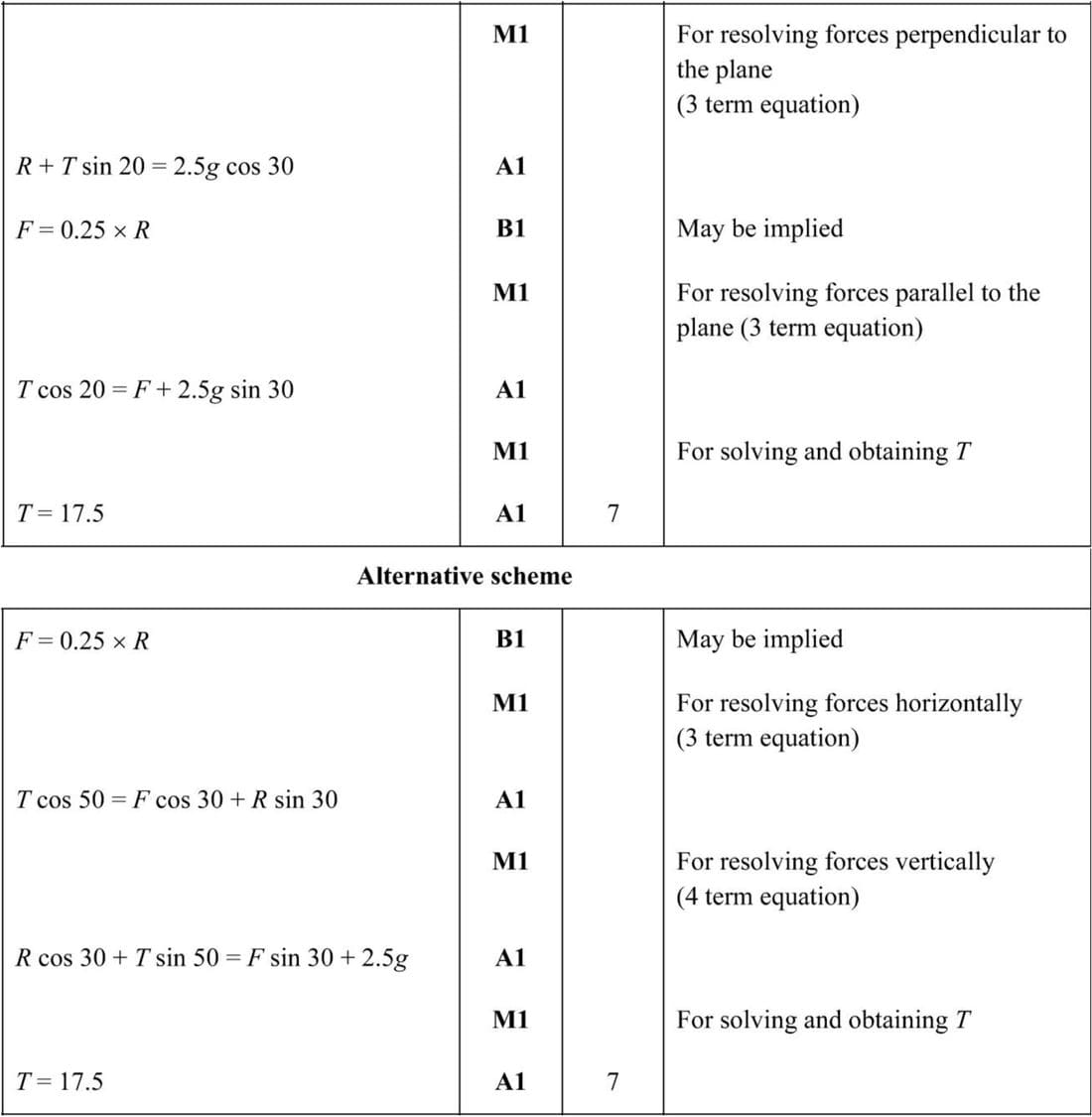
\(R + T \sin 20^{\circ} = 2.5g \cos 30^{\circ}\)
Step 2: Friction force.
The friction force \(F\) is given by:
\(F = 0.25 \times R\)
Step 3: Resolve forces parallel to the plane.
The tension component \(T \cos 20^{\circ}\) acts up the plane, while the friction force \(F\) and the weight component \(2.5g \sin 30^{\circ}\) act down the plane.
Thus, the equation is:
\(T \cos 20^{\circ} = F + 2.5g \sin 30^{\circ}\)
Step 4: Solve the equations.
Substitute \(F = 0.25 \times R\) into the parallel force equation:
\(T \cos 20^{\circ} = 0.25R + 2.5g \sin 30^{\circ}\)
Using the perpendicular force equation, solve for \(R\):
\(R = 2.5g \cos 30^{\circ} - T \sin 20^{\circ}\)
Substitute \(R\) into the parallel force equation and solve for \(T\):
\(T \cos 20^{\circ} = 0.25(2.5g \cos 30^{\circ} - T \sin 20^{\circ}) + 2.5g \sin 30^{\circ}\)
Solving this equation gives \(T = 17.5\).