9709 P43 - Jun 2010 - Q7
3991
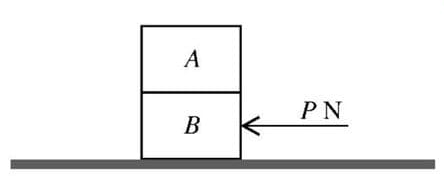
Two rectangular boxes A and B are of identical size. The boxes are at rest on a rough horizontal floor with A on top of B. Box A has mass 200 kg and box B has mass 250 kg. A horizontal force of magnitude P N is applied to B (see diagram). The boxes remain at rest if P \leq 3150 and start to move if P > 3150.
- Find the coefficient of friction between B and the floor.
- Given that P > 3150 and that no sliding takes place between the boxes, show that the acceleration of the boxes is not greater than 2 \text{ m s}^{-2}.
- Find the maximum possible value of P.
Solutions locked. Please sign in with access to view them.