Browsing as Guest. Progress, bookmarks and attempts are disabled.
Log in to track your work.
Nov 2014 p42 q4
3966
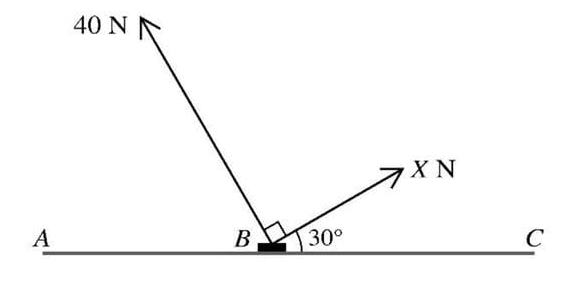
Forces of magnitude \(X \text{ N}\) and \(40 \text{ N}\) act on a block \(B\) of mass \(15 \text{ kg}\), which is in equilibrium in contact with a horizontal surface between points \(A\) and \(C\) on the surface. The forces act in the same vertical plane and in the directions shown in the diagram.
(i) Given that the surface is smooth, find the value of \(X\).
(ii) It is given instead that the surface is rough and that the block is in limiting equilibrium. The frictional force acting on the block has magnitude \(10 \text{ N}\) in the direction towards \(A\). Find the coefficient of friction between the block and the surface.
Solution
(i) Since the surface is smooth, there is no friction. The block is in equilibrium, so the horizontal components of the forces must balance. The horizontal component of the \(40 \text{ N}\) force is \(40 \cos(90^\circ) = 0\). The horizontal component of the \(X \text{ N}\) force is \(X \cos(30^\circ)\). Therefore, \(X \cos(30^\circ) = 0\), which implies \(X = 20 \text{ N}\).
(ii) For the rough surface, the block is in limiting equilibrium, so the frictional force \(F = 10 \text{ N}\) acts towards \(A\). The normal reaction \(R\) is equal to the weight of the block, \(R = 15g\). The frictional force is given by \(F = \mu R\), so \(10 = \mu \times 15g\). Solving for \(\mu\), we get \(\mu = \frac{10}{15g} = 0.5\).