9709 P41 - Nov 2009 - Q6
3952
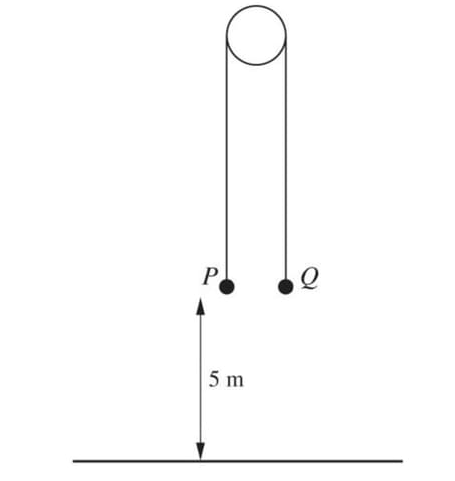
Particles P and Q, of masses 0.55 kg and 0.45 kg respectively, are attached to the ends of a light inextensible string which passes over a smooth fixed pulley. The particles are held at rest with the string taut and its straight parts vertical. Both particles are at a height of 5 m above the ground (see diagram). The system is released.
(i) Find the acceleration with which P starts to move. [3]
The string breaks after 2 s and in the subsequent motion P and Q move vertically under gravity.
(ii) At the instant that the string breaks, find
- the height above the ground of P and of Q,
- the speed of the particles.
(iii) Show that Q reaches the ground 0.8 s later than P. [4]
Solutions locked. Please sign in with access to view them.