9709 P43 - Nov 2013 - Q2
3943
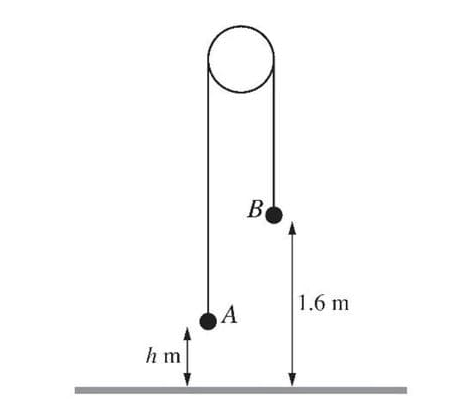
Particle A of mass 0.2 kg and particle B of mass 0.6 kg are attached to the ends of a light inextensible string. The string passes over a fixed smooth pulley. B is held at rest at a height of 1.6 m above the floor. A hangs freely at a height of h m above the floor. Both straight parts of the string are vertical (see diagram). B is released and both particles start to move. When B reaches the floor it remains at rest, but A continues to move vertically upwards until it reaches a height of 3 m above the floor. Find the speed of B immediately before it hits the floor, and hence find the value of h.
Solutions locked. Please sign in with access to view them.