Browsing as Guest. Progress, bookmarks and attempts are disabled.
Log in to track your work.
June 2012 p42 q5
3932
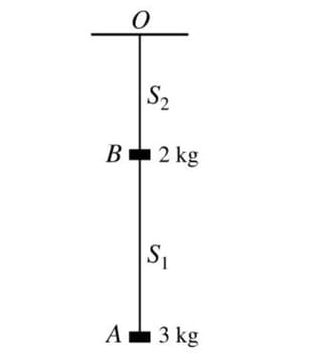
A block A of mass 3 kg is attached to one end of a light inextensible string S1. Another block B of mass 2 kg is attached to the other end of S1, and is also attached to one end of another light inextensible string S2. The other end of S2 is attached to a fixed point O and the blocks hang in equilibrium below O (see diagram).
Find the tension in S1 and the tension in S2.
The string S2 breaks and the particles fall. The air resistance on A is 1.6 N and the air resistance on B is 4 N.
Find the acceleration of the particles and the tension in S1.
Solution
(i) For block B in equilibrium, the tension in S2 must balance the weight of both blocks. Therefore, the tension in S2 is given by:
\(T_{S_2} = (3 + 2)g = 5g = 50 \text{ N}\)
For block A, the tension in S1 must balance the weight of block A alone. Therefore, the tension in S1 is:
\(T_{S_1} = 3g = 30 \text{ N}\)
(ii) After S2 breaks, apply Newton's second law to each block. For block A:
\(3g - T - 1.6 = 3a\)
For block B:
\(2g + T - 4 = 2a\)
Adding these equations:
\((3g + 2g) - (1.6 + 4) = (3 + 2)a\)
\(5g - 5.6 = 5a\)
\(a = \frac{5g - 5.6}{5} = 8.88 \text{ m/s}^2\)
Substitute \(a\) back into one of the equations to find \(T\):