Browsing as Guest. Progress, bookmarks and attempts are disabled.
Log in to track your work.
Nov 2021 p43 q6
3896
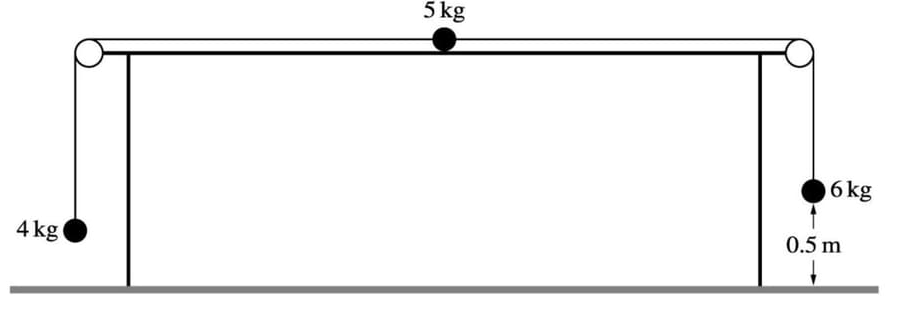
The diagram shows a particle of mass 5 kg on a rough horizontal table, and two light inextensible strings attached to it passing over smooth pulleys fixed at the edges of the table. Particles of masses 4 kg and 6 kg hang freely at the ends of the strings. The particle of mass 6 kg is 0.5 m above the ground. The system is in limiting equilibrium.
(a) Show that the coefficient of friction between the 5 kg particle and the table is 0.4.
The 6 kg particle is now replaced by a particle of mass 8 kg and the system is released from rest.
(b) Find the acceleration of the 4 kg particle and the tensions in the strings.
(c) In the subsequent motion the 8 kg particle hits the ground and does not rebound. Find the time that elapses after the 8 kg particle hits the ground before the other two particles come to instantaneous rest. (You may assume this occurs before either particle reaches a pulley.)
Solution
(a) Resolve forces for the 5 kg particle: The normal reaction is given by the weight of the 5 kg particle, so \(R = 5g\). The frictional force \(F\) is the difference between the weight of the 6 kg particle and the 4 kg particle, so \(F = 6g - 4g = 2g\). The coefficient of friction \(\mu\) is given by \(\mu = \frac{F}{R} = \frac{2g}{5g} = 0.4\).
(b) Apply Newton's second law to the 4 kg and 8 kg particles: For the 4 kg particle, \(T_1 - 4g = 4a\). For the 8 kg particle, \(8g - T_2 = 8a\). The tension difference is \(T_2 - T_1 = F = 0.4 \times 5g\). Adding the equations gives \(8g - 4g - 2g = 17a\), leading to \(a = 1.18 \text{ m/s}^2\). Solving for tensions, \(T_1 = 44.7 \text{ N}\) and \(T_2 = 70.6 \text{ N}\).
(c) For the 8 kg particle, \(T - 4g = 4a\) and \(-T - F = 5a\), or \(-4g - 2g = 9a\). Solving gives \(a = \frac{60}{9}\). Use \(v^2 = u^2 + 2as\) to find \(v\) when the 8 kg particle reaches the ground: \(v^2 = 2 \times \frac{20}{17} \times 0.5 = \frac{20}{17}\), leading to \(v = 1.0846 \ldots\). Use \(v = u + at\) to find \(t\): \(0 = \frac{20}{17} - \frac{60}{9}t\), giving \(t = 0.163 \text{ s}\).