9709 P4 - Jun 2006 - Q5
3895
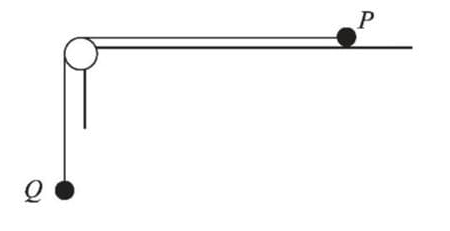
Particles P and Q are attached to opposite ends of a light inextensible string. P is at rest on a rough horizontal table. The string passes over a small smooth pulley which is fixed at the edge of the table. Q hangs vertically below the pulley (see diagram). The force exerted on the string by the pulley has magnitude \(4\sqrt{2}\) N. The coefficient of friction between P and the table is 0.8.
- Show that the tension in the string is 4 N and state the mass of Q.
- Given that P is on the point of slipping, find its mass.
- A particle of mass 0.1 kg is now attached to Q and the system starts to move. Find the tension in the string while the particles are in motion.
Solutions locked. Please sign in with access to view them.