Browsing as Guest. Progress, bookmarks and attempts are disabled.
Log in to track your work.
Problem 388
388
The equation of a curve is \(y = x^2 - 3x + 4\).
(i) Show that the whole of the curve lies above the \(x\)-axis.
(ii) Find the set of values of \(x\) for which \(x^2 - 3x + 4\) is a decreasing function of \(x\).
The equation of a line is \(y + 2x = k\), where \(k\) is a constant.
(iii) In the case where \(k = 6\), find the coordinates of the points of intersection of the line and the curve.
(iv) Find the value of \(k\) for which the line is a tangent to the curve.
Solution
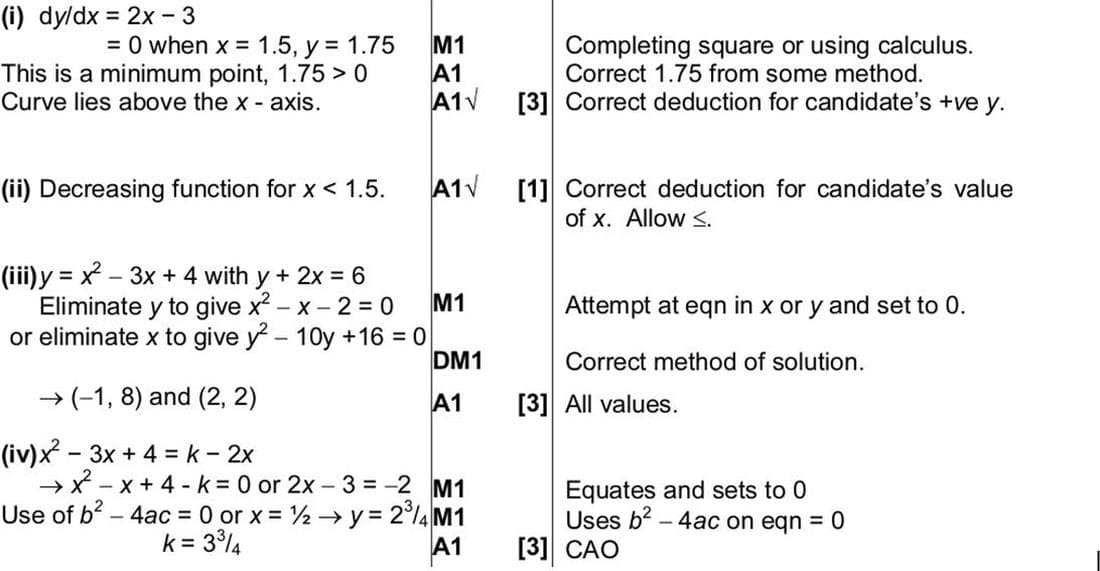
(i) To show the curve lies above the \(x\)-axis, find the vertex of the parabola. The derivative is \(\frac{dy}{dx} = 2x - 3\). Setting \(\frac{dy}{dx} = 0\) gives \(x = 1.5\). Substituting \(x = 1.5\) into the equation gives \(y = 1.75\). Since the minimum point \(y = 1.75 > 0\), the curve lies above the \(x\)-axis.
(ii) The function is decreasing where \(\frac{dy}{dx} < 0\). Solving \(2x - 3 < 0\) gives \(x < 1.5\).
(iii) Substitute \(y = 6 - 2x\) into \(y = x^2 - 3x + 4\) to get \(x^2 - x - 2 = 0\). Solving gives \(x = -1\) and \(x = 2\). Substituting back gives points \((-1, 8)\) and \((2, 2)\).
(iv) For the line to be tangent, the discriminant of \(x^2 - 3x + 4 - k + 2x = 0\) must be zero. Simplifying gives \(x^2 - x + (4 - k) = 0\). The discriminant is \(b^2 - 4ac = 1^2 - 4(1)(4-k) = 0\). Solving gives \(k = \frac{3}{4}\).