9709 P13 - Nov 2011 - Q3
387
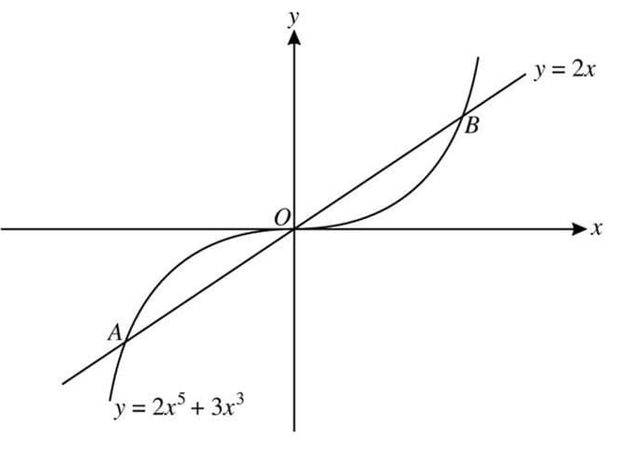
The diagram shows the curve \(y = 2x^5 + 3x^3\) and the line \(y = 2x\) intersecting at points \(A, O\) and \(B\).
(i) Show that the \(x\)-coordinates of \(A\) and \(B\) satisfy the equation \(2x^4 + 3x^2 - 2 = 0\).
(ii) Solve the equation \(2x^4 + 3x^2 - 2 = 0\) and hence find the coordinates of \(A\) and \(B\), giving your answers in an exact form.
Solutions locked. Please sign in with access to view them.