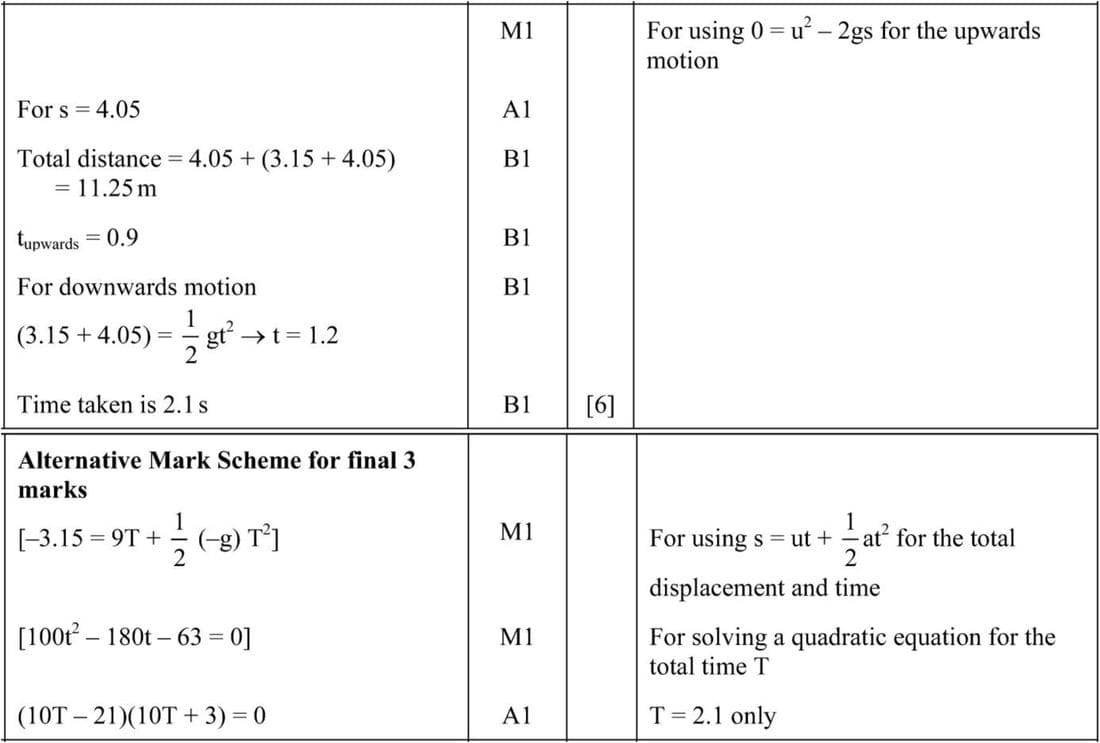
First, calculate the maximum height reached by the particle. Using the equation for upward motion:
\(0 = u^2 - 2gs\)
where \(u = 9 \text{ m/s}\) and \(g = 9.8 \text{ m/s}^2\). Solving for \(s\):
\(0 = 9^2 - 2 \times 9.8 \times s\)
\(s = \frac{81}{19.6} = 4.05 \text{ m}\)
The total distance travelled is the sum of the distance upwards and downwards:
\(\text{Total distance} = 4.05 + (3.15 + 4.05) = 11.25 \text{ m}\)
Next, calculate the time taken to reach the maximum height:
\(v = u - gt\)
Setting \(v = 0\):
\(0 = 9 - 9.8t\)
\(t = \frac{9}{9.8} = 0.9 \text{ s}\)
For the downward motion, use:
\(s = \frac{1}{2} gt^2\)
where \(s = 3.15 + 4.05 = 7.2 \text{ m}\):
\(7.2 = \frac{1}{2} \times 9.8 \times t^2\)
\(t^2 = \frac{14.4}{9.8}\)
\(t = 1.2 \text{ s}\)
The total time taken is:
\(\text{Total time} = 0.9 + 1.2 = 2.1 \text{ s}\)