Browsing as Guest. Progress, bookmarks and attempts are disabled.
Log in to track your work.
Nov 2015 p42 q2
3861
A particle is released from rest at a point H m above horizontal ground and falls vertically. The particle passes through a point 35 m above the ground with a speed of
(V - 10) \text{ m s}^{-1} and reaches the ground with a speed of V \text{ m s}^{-1}. Find
the value of V,
the value of H.
Solution
To solve for V and H, we use the equations of motion under gravity. Assume acceleration due to gravity is \(g\).
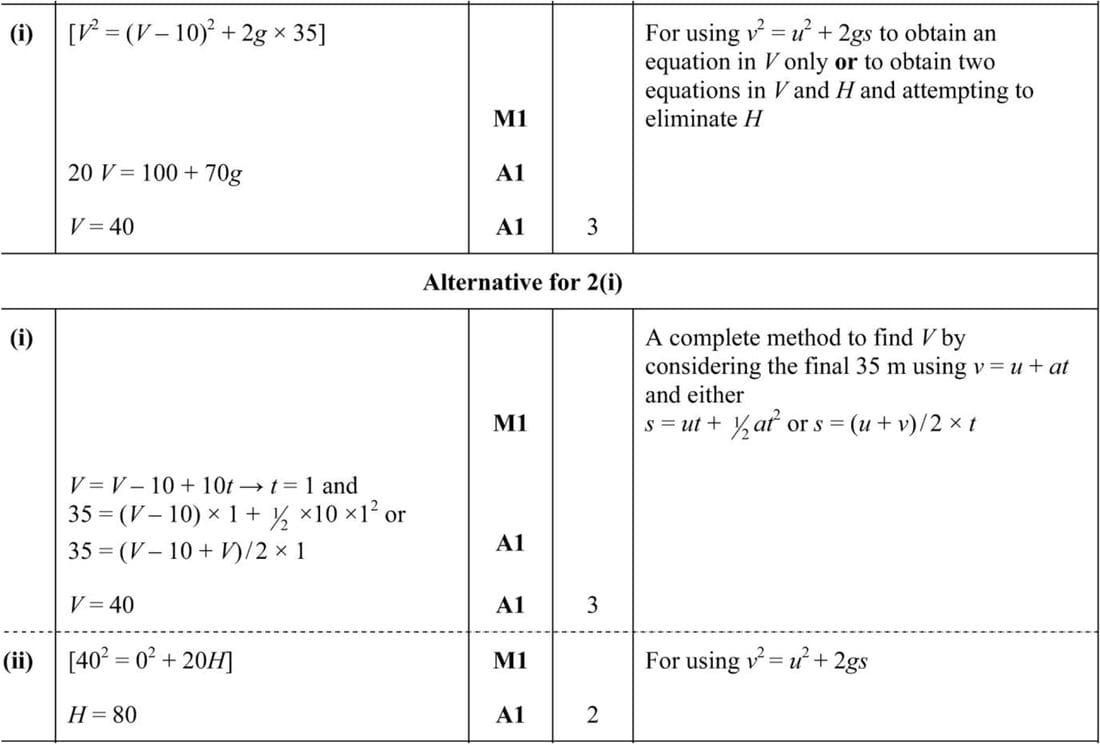
(i) Finding \(V\):
Using the equation \(v^2 = u^2 + 2gs\), where \(u\) is the initial velocity, \(v\) is the final velocity, and \(s\) is the displacement:
For the section from 35 m above the ground to the ground:
\(V^2 = (V - 10)^2 + 2g \times 35\)
Expanding and simplifying:
\(V^2 = V^2 - 20V + 100 + 70g\)
\(20V = 100 + 70g\)
Assuming \(g = 10 \text{ m s}^{-2}\):
\(20V = 100 + 700\)
\(20V = 800\)
\(V = 40\)
(ii) Finding \(H\):
Using the equation \(v^2 = u^2 + 2gs\) for the entire fall from H to the ground: