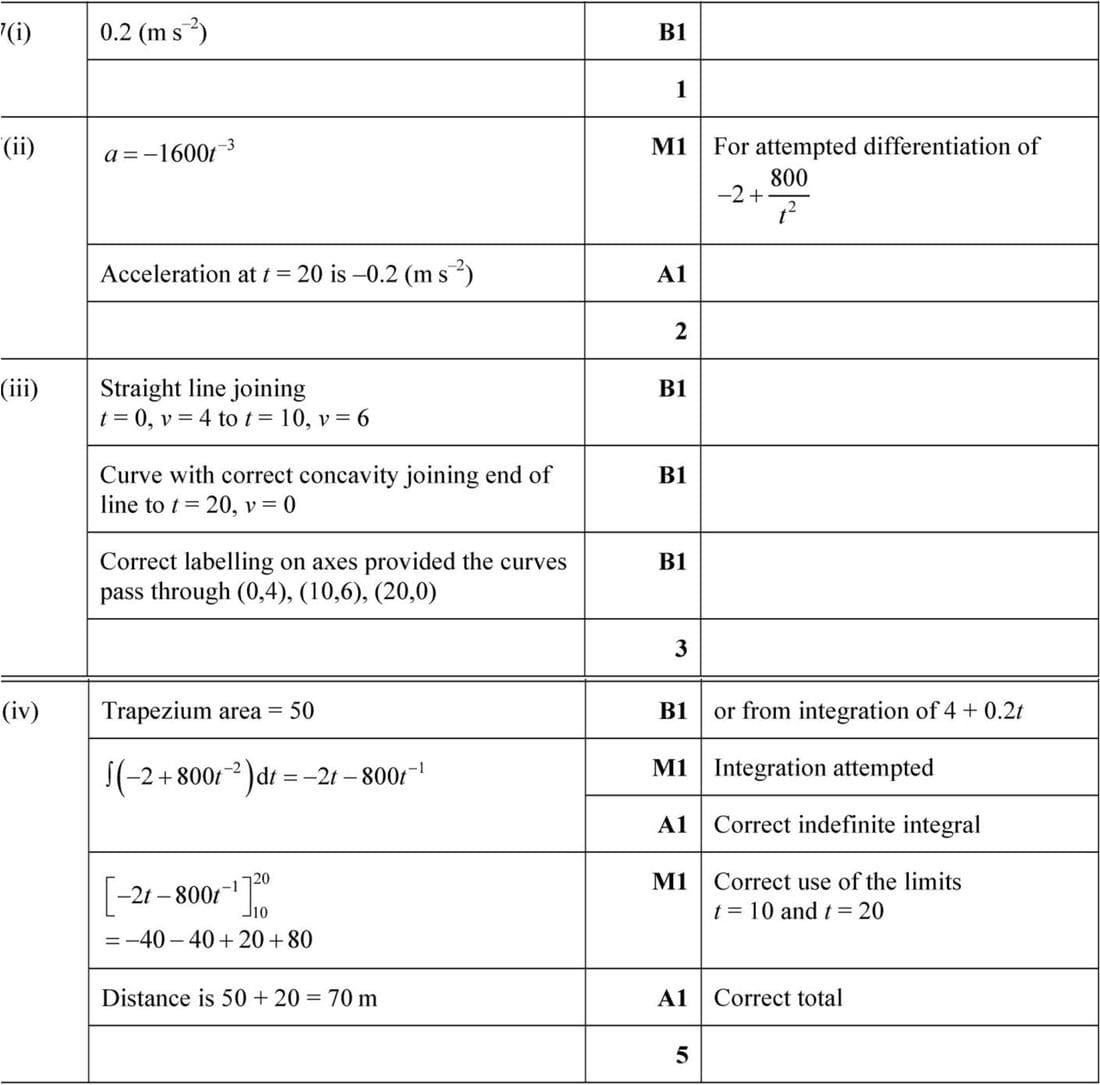
(i) The velocity function for \(0 \leq t \leq 10\) is \(v = 4 + 0.2t\). The acceleration is the derivative of velocity with respect to time:
\(a = \frac{dv}{dt} = 0.2\) m s-2.
(ii) For \(10 \leq t \leq 20\), the velocity function is \(v = -2 + \frac{800}{t^2}\). The acceleration is:
\(a = \frac{dv}{dt} = -\frac{d}{dt}\left(2 - \frac{800}{t^2}\right) = \frac{1600}{t^3}\).
At \(t = 20\), \(a = \frac{1600}{20^3} = -0.2\) m s-2.
(iii) The velocity-time graph consists of a straight line from \((0, 4)\) to \((10, 6)\) and a curve from \((10, 6)\) to \((20, 0)\) with correct concavity.
(iv) The total distance is the area under the velocity-time graph. For \(0 \leq t \leq 10\), the area is a trapezium:
\(\text{Area} = \frac{1}{2} \times (4 + 6) \times 10 = 50\) m.
For \(10 \leq t \leq 20\), integrate \(v = -2 + \frac{800}{t^2}\):
\(\int_{10}^{20} \left(-2 + \frac{800}{t^2}\right) dt = \left[-2t - \frac{800}{t}\right]_{10}^{20} = (-40 - 40 + 20 + 80) = 20\) m.
\(Total distance = 50 + 20 = 70 m.\)