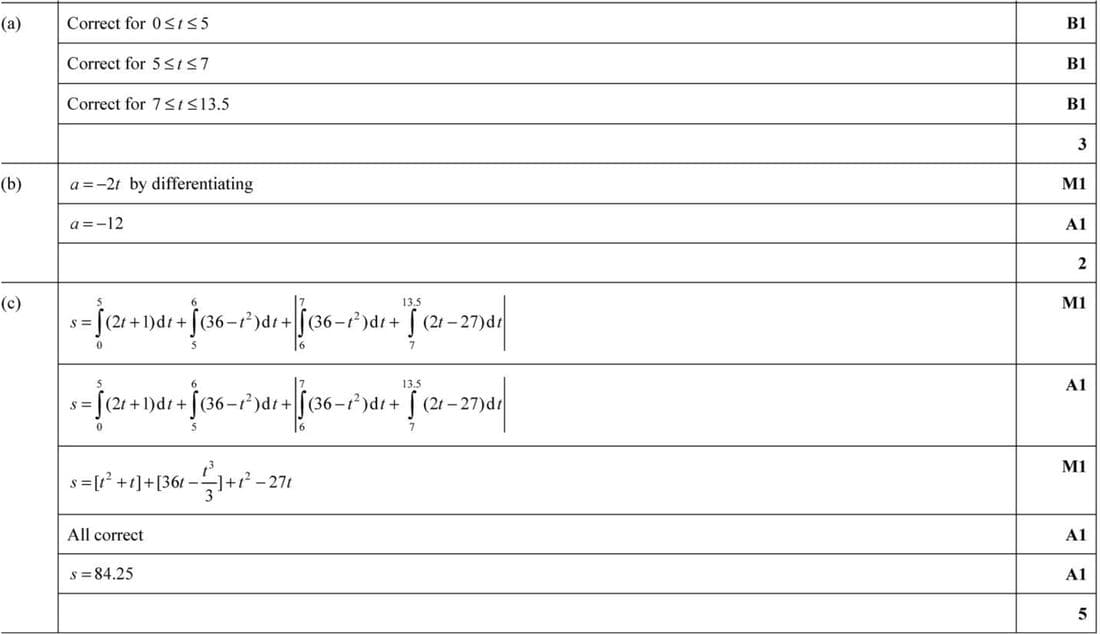
(a) The velocity-time graph consists of three segments:
- For \(0 \leq t \leq 5\), the graph is a straight line with equation \(v = 2t + 1\).
- For \(5 \leq t \leq 7\), the graph is a downward-opening parabola with equation \(v = 36 - t^2\).
- For \(7 \leq t \leq 13.5\), the graph is a straight line with equation \(v = 2t - 27\).
(b) To find the acceleration at \(t = 6\), differentiate the velocity function for \(5 \leq t \leq 7\):
\(v = 36 - t^2\)
\(a = \frac{dv}{dt} = -2t\)
At \(t = 6\), \(a = -2(6) = -12\).
(c) The total distance travelled is the integral of the absolute value of velocity over the given intervals:
\(s = \int_{0}^{5} (2t + 1) \, dt + \int_{5}^{6} (36 - t^2) \, dt + \int_{6}^{7} (36 - t^2) \, dt + \int_{7}^{13.5} (2t - 27) \, dt\)
Calculate each integral:
\(\int_{0}^{5} (2t + 1) \, dt = [t^2 + t]_{0}^{5} = 25 + 5 = 30\)
\(\int_{5}^{6} (36 - t^2) \, dt = [36t - \frac{t^3}{3}]_{5}^{6} = (216 - 72) - (180 - \frac{125}{3}) = 36 - 41.67 = -5.67\)
\(\int_{6}^{7} (36 - t^2) \, dt = [36t - \frac{t^3}{3}]_{6}^{7} = (252 - \frac{343}{3}) - (216 - 72) = 36 - 41.67 = -5.67\)
\(\int_{7}^{13.5} (2t - 27) \, dt = [t^2 - 27t]_{7}^{13.5} = (182.25 - 364.5) - (49 - 189) = -182.25 + 140 = -42.25\)
Total distance \(s = 30 + 5.67 + 5.67 + 42.25 = 84.25\).