9709 P42 - Jun 2021 - Q7
3844
A particle P moving in a straight line starts from rest at a point O and comes to rest 16 s later. At time t s after leaving O, the acceleration a m s-2 of P is given by
\(a = 6 + 4t \quad 0 \leq t < 2,\) \(a = 14 \quad 2 \leq t < 4,\) \(a = 16 - 2t \quad 4 \leq t \leq 16.\)
There is no sudden change in velocity at any instant.
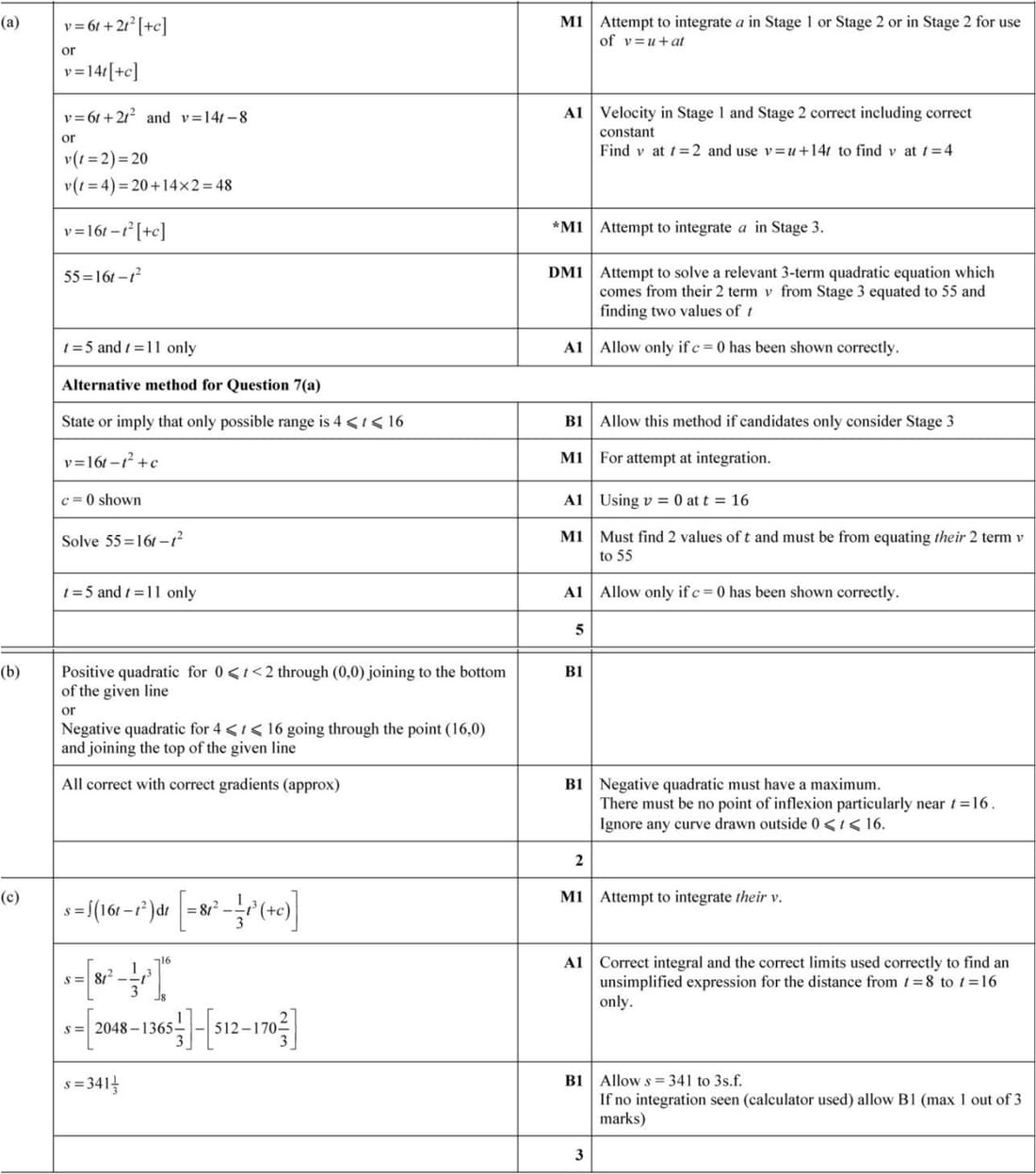
- Find the values of t when the velocity of P is 55 m s-1.
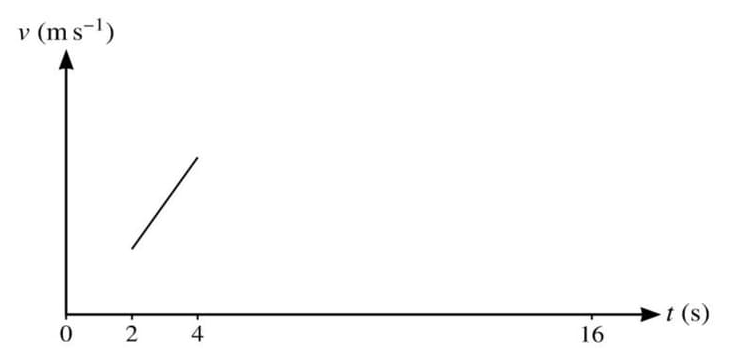
- Complete the sketch of the velocity-time diagram.
- Find the distance travelled by P when it is decelerating.