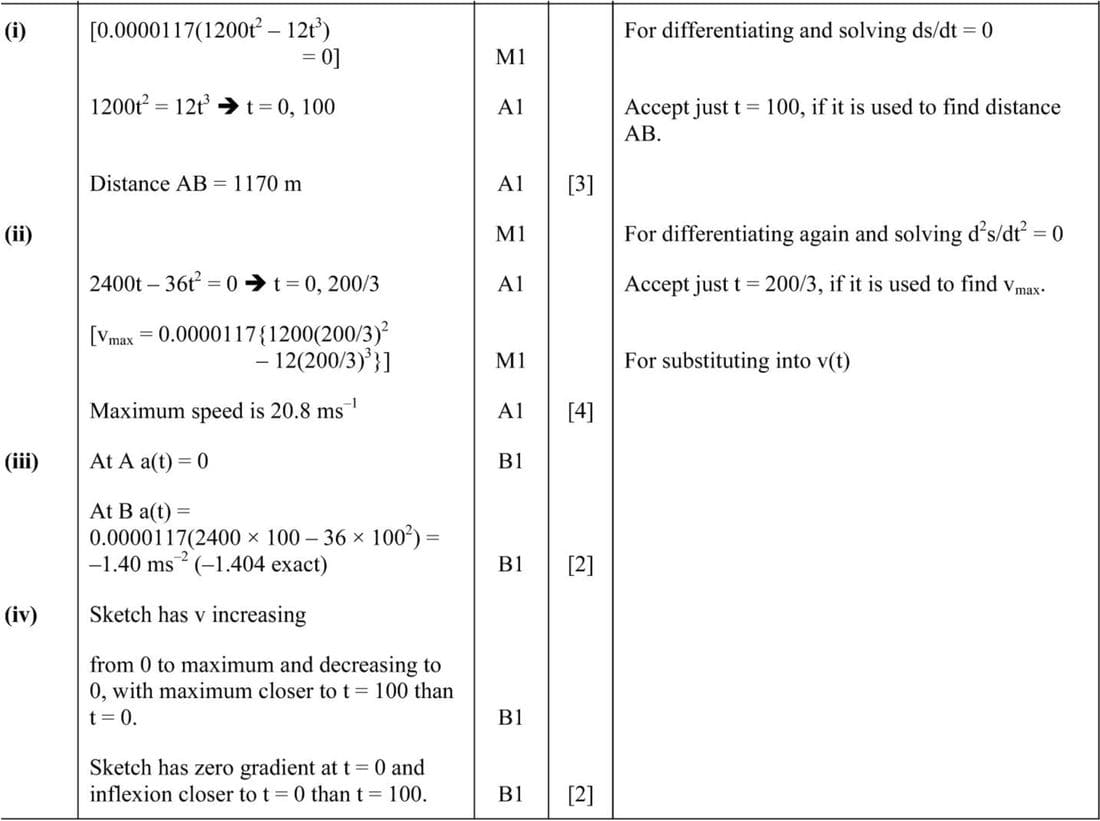
(i) To find the distance AB, set the derivative of the distance function to zero to find when the car stops:
\(\frac{d}{dt}[0.0000117(400t^3 - 3t^4)] = 0\)
\(0.0000117(1200t^2 - 12t^3) = 0\)
\(1200t^2 = 12t^3\)
\(t = 0, 100\)
Distance \(AB = 0.0000117(400(100)^3 - 3(100)^4) = 1170\) m.
(ii) To find the maximum speed, differentiate the velocity function and set it to zero:
\(v(t) = \frac{d}{dt}[0.0000117(400t^3 - 3t^4)] = 0.0000117(1200t^2 - 12t^3)\)
\(\frac{d}{dt}[v(t)] = 0.0000117(2400t - 36t^2) = 0\)
\(2400t = 36t^2\)
\(t = 0, \frac{200}{3}\)
Maximum speed \(v_{\text{max}} = 0.0000117(1200(\frac{200}{3})^2 - 12(\frac{200}{3})^3) = 20.8\) m/s.
(iii) (a) At A, \(a(t) = 0\).
(b) At B, \(a(t) = 0.0000117(2400 \times 100 - 36 \times 100^2) = -1.40\) m/s2.
(iv) The velocity-time graph starts at zero, increases to a maximum, and then decreases back to zero. The maximum is closer to \(t = 100\) than \(t = 0\). The graph has a zero gradient at \(t = 0\) and an inflection point closer to \(t = 0\) than \(t = 100\).