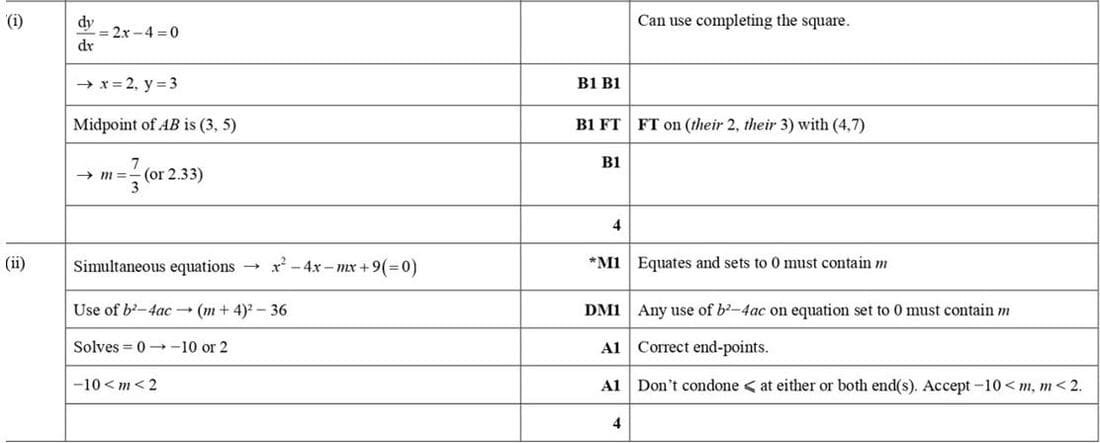
(i) To find the stationary point B, we set the derivative of the curve to zero: \(\frac{dy}{dx} = 2x - 4 = 0\). Solving gives \(x = 2\). Substituting \(x = 2\) into the curve equation gives \(y = 3\). Thus, B is (2, 3).
The midpoint of AB is \(\left( \frac{4+2}{2}, \frac{7+3}{2} \right) = (3, 5)\).
Since L passes through this midpoint, substitute (3, 5) into \(y = mx - 2\):
\(5 = 3m - 2\)
Solving for \(m\), we get \(m = \frac{7}{3}\).
(ii) The line L does not meet the curve if the quadratic equation formed by substituting \(y = mx - 2\) into the curve equation has no real solutions. This occurs when the discriminant is less than zero.
Substitute \(y = mx - 2\) into \(y = x^2 - 4x + 7\):
\(x^2 - 4x + 7 = mx - 2\)
Rearrange to form a quadratic: \(x^2 - (4+m)x + 9 = 0\)
The discriminant \(b^2 - 4ac\) is \((m+4)^2 - 36\).
Set \((m+4)^2 - 36 < 0\) and solve:
\((m+4)^2 < 36\)
\(-6 < m+4 < 6\)
\(-10 < m < 2\)