Browsing as Guest. Progress, bookmarks and attempts are disabled.
Log in to track your work.
June 2015 p43 q7
3838
A particle P moves on a straight line. It starts at a point O on the line and returns to O 100 s later. The velocity of P is v m s-1 at time t s after leaving O, where
\(v = 0.0001t^3 - 0.015t^2 + 0.5t\).
Show that P is instantaneously at rest when \(t = 0\), \(t = 50\) and \(t = 100\).
Find the values of \(v\) at the times for which the acceleration of P is zero, and sketch the velocity-time graph for P's motion for \(0 \leq t \leq 100\).
Find the greatest distance of P from O for \(0 \leq t \leq 100\).
Solution
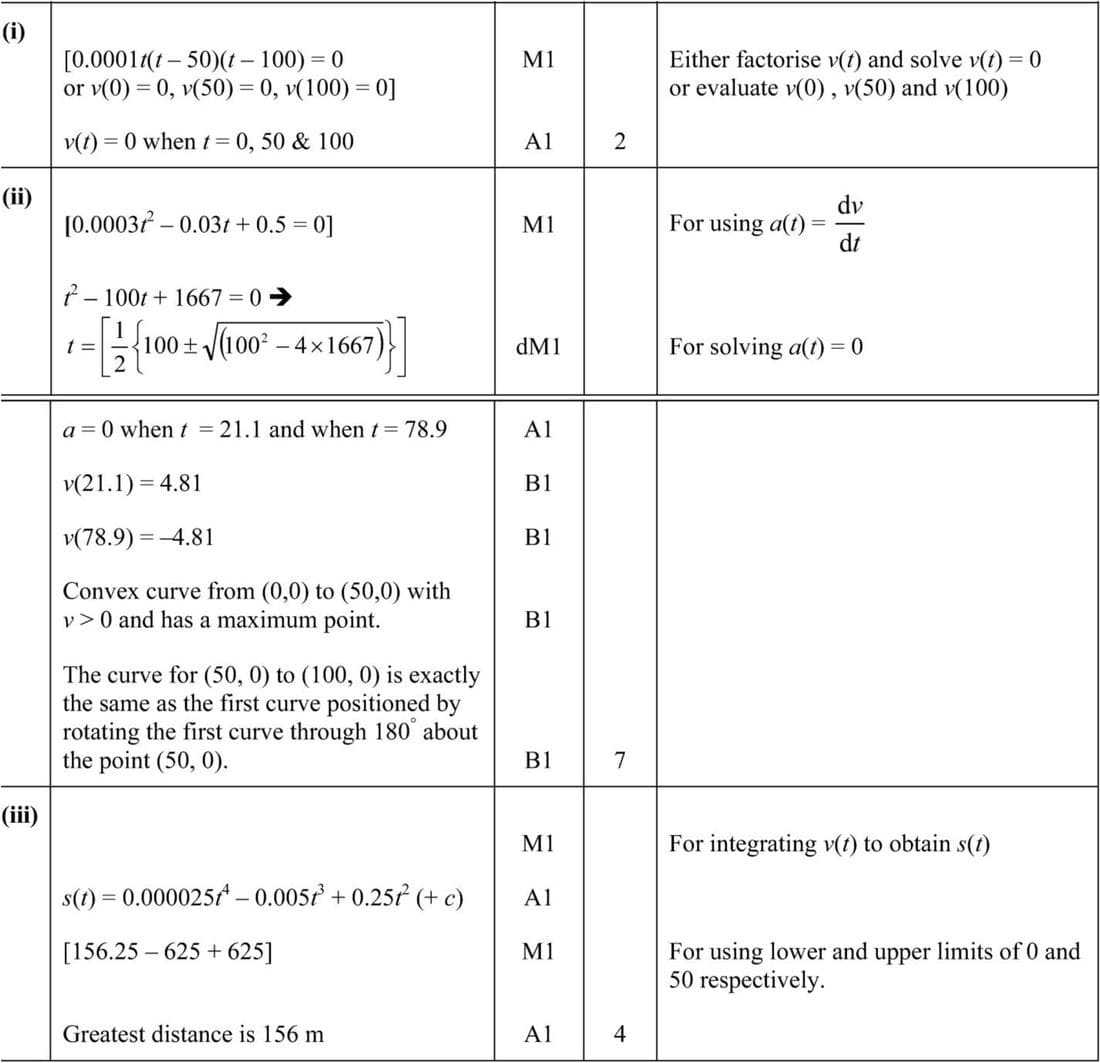
(i) To show that P is at rest, we need \(v(t) = 0\). The velocity function is \(v(t) = 0.0001t^3 - 0.015t^2 + 0.5t\). Factorizing gives \(0.0001t(t - 50)(t - 100) = 0\). Thus, \(v(t) = 0\) when \(t = 0, 50, 100\).
(ii) The acceleration \(a(t)\) is the derivative of \(v(t)\): \(a(t) = \frac{dv}{dt} = 0.0003t^2 - 0.03t + 0.5\). Setting \(a(t) = 0\) gives \(0.0003t^2 - 0.03t + 0.5 = 0\). Solving this quadratic equation, \(t^2 - 100t + 1667 = 0\), we find \(t = 21.1\) and \(t = 78.9\). The velocities are \(v(21.1) = 4.81\) and \(v(78.9) = -4.81\). The velocity-time graph is a convex curve from \((0,0)\) to \((50,0)\) with \(v > 0\) and a maximum point. The curve from \((50,0)\) to \((100,0)\) is the first curve rotated 180° about \((50,0)\).
(iii) To find the greatest distance, integrate \(v(t)\) to get the displacement \(s(t)\): \(s(t) = 0.000025t^4 - 0.005t^3 + 0.25t^2 + c\). Using limits \(t = 0\) and \(t = 50\), the greatest distance is \(156\) m.