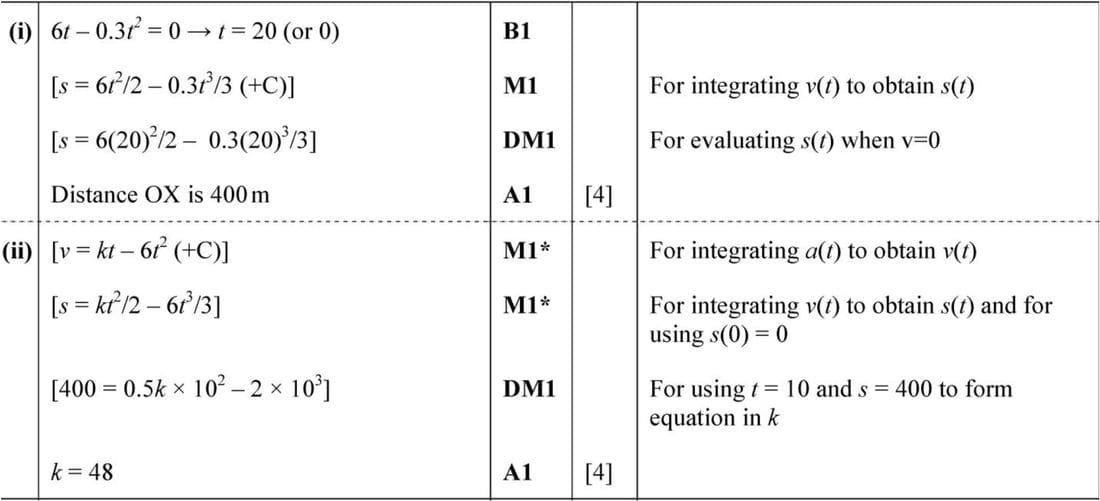
(i) To find the distance OX, we first determine when the particle P comes to rest. This occurs when the velocity v = 0. Given v = 6t - 0.3t^2, set it to zero:
\(6t - 0.3t^2 = 0\)
Factor out \(t\):
\(t(6 - 0.3t) = 0\)
Thus, \(t = 0\) or \(t = 20\).
Since the particle starts at \(t = 0\), it comes to rest at \(t = 20\).
To find the distance, integrate the velocity function to get the displacement function \(s(t)\):
\(s(t) = \int (6t - 0.3t^2) \, dt = 3t^2 - 0.1t^3 + C\)
Since the particle starts from O, \(s(0) = 0\), so \(C = 0\).
Evaluate \(s(t)\) at \(t = 20\):
\(s(20) = 3(20)^2 - 0.1(20)^3 = 1200 - 800 = 400\)
Thus, the distance OX is 400 m.
(ii) For particle Q, the acceleration is given by \(a = k - 12t\). Integrate to find the velocity:
\(v(t) = \int (k - 12t) \, dt = kt - 6t^2 + C\)
Since Q starts from rest, \(v(0) = 0\), so \(C = 0\).
Integrate the velocity to find the displacement:
\(s(t) = \int (kt - 6t^2) \, dt = \frac{kt^2}{2} - 2t^3 + C\)
Since Q starts from O, \(s(0) = 0\), so \(C = 0\).
Given \(s(10) = 400\), substitute \(t = 10\):
\(400 = \frac{k(10)^2}{2} - 2(10)^3\)
\(400 = 50k - 2000\)
\(2400 = 50k\)
\(k = 48\)