9709 P12 - Nov 2018 - Q3
383
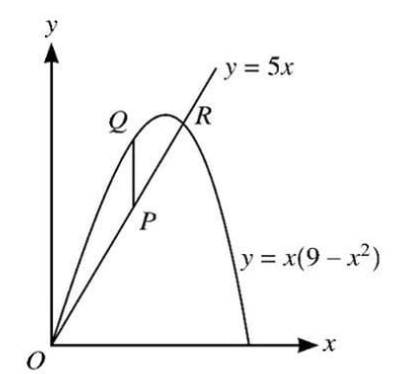
The diagram shows part of the curve \(y = x(9 - x^2)\) and the line \(y = 5x\), intersecting at the origin \(O\) and the point \(R\). Point \(P\) lies on the line \(y = 5x\) between \(O\) and \(R\) and the \(x\)-coordinate of \(P\) is \(t\). Point \(Q\) lies on the curve and \(PQ\) is parallel to the \(y\)-axis.
- Express the length of \(PQ\) in terms of \(t\), simplifying your answer.
- Given that \(t\) can vary, find the maximum value of the length of \(PQ\).
Solutions locked. Please sign in with access to view them.