9709 P41 - Nov 2019 - Q7
3828
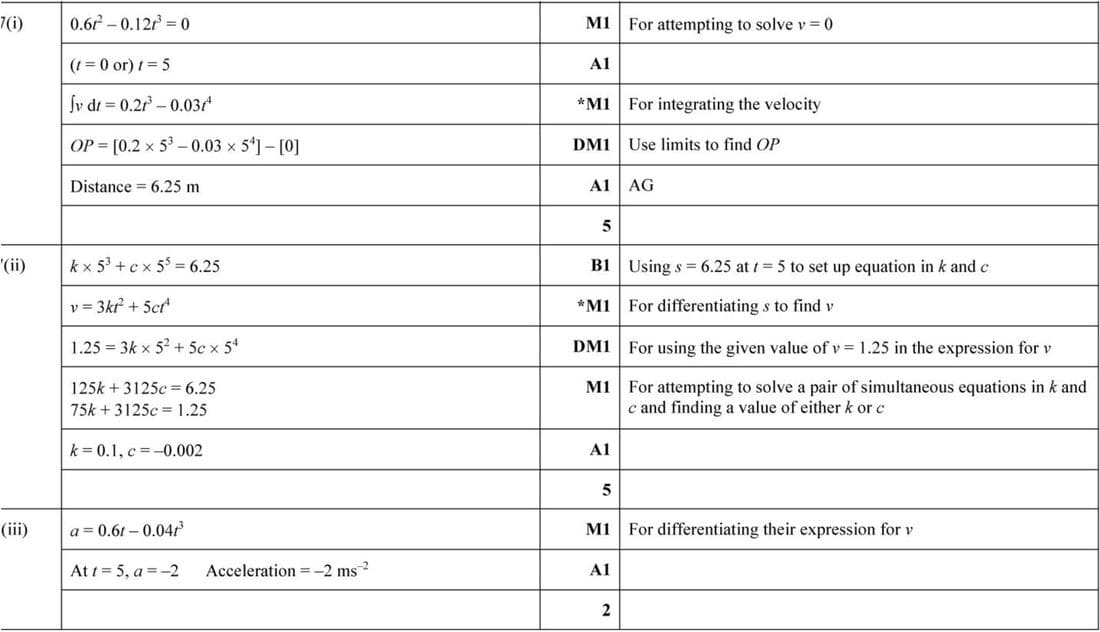
A particle moves in a straight line, starting from rest at a point O, and comes to instantaneous rest at a point P. The velocity of the particle at time t s after leaving O is v m s-1, where
\(v = 0.6t^2 - 0.12t^3\).
- Show that the distance OP is 6.25 m.
On another occasion, the particle also moves in the same straight line. On this occasion, the displacement of the particle at time t s after leaving O is s m, where
\(s = kt^3 + ct^5\).
\(It is given that the particle passes point P with velocity 1.25 m s-1 at time t = 5.\)
- Find the values of the constants k and c.
- Find the acceleration of the particle at time t = 5.