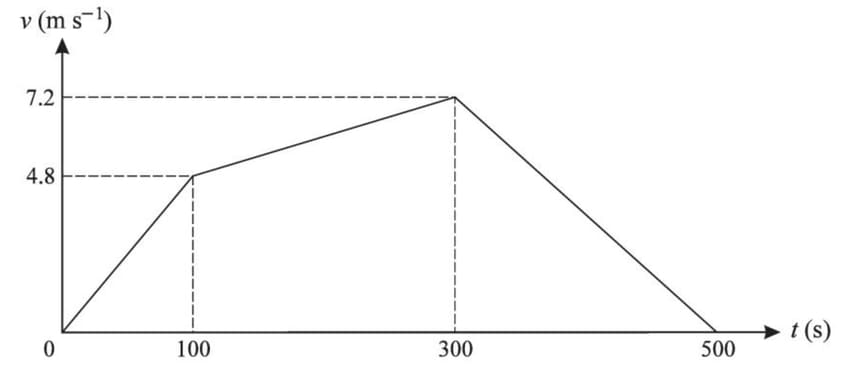
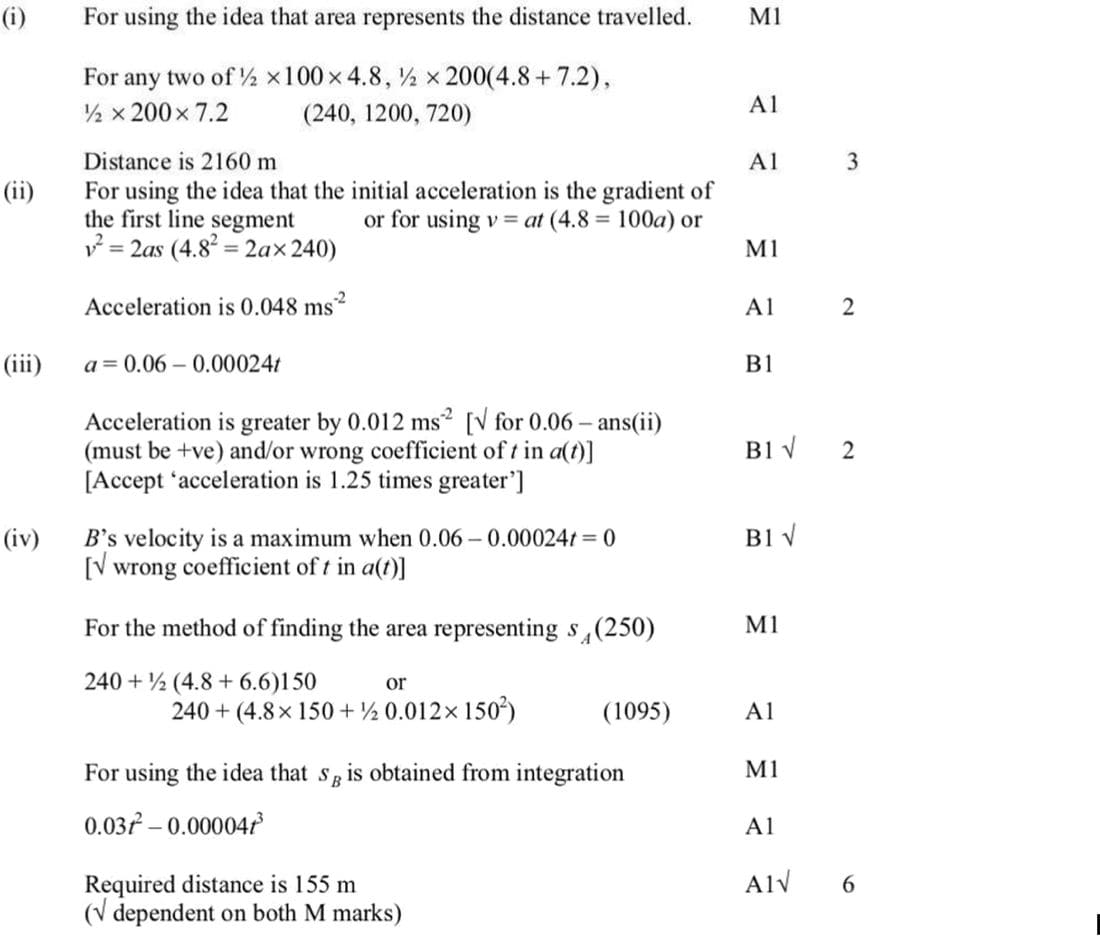
(i) The distance travelled by A is the area under the velocity-time graph. The graph consists of three segments: a triangle, a trapezium, and another triangle.
For the first triangle (0 to 100 s):
Area = \(\frac{1}{2} \times 100 \times 4.8 = 240\) m
For the trapezium (100 to 300 s):
Area = \(\frac{1}{2} \times 200 \times (4.8 + 7.2) = 1200\) m
For the second triangle (300 to 500 s):
Area = \(\frac{1}{2} \times 200 \times 7.2 = 720\) m
\(Total distance = 240 + 1200 + 720 = 2160 m\)
(ii) The initial acceleration of A is the gradient of the first line segment of the graph.
Acceleration \(a = \frac{4.8}{100} = 0.048\) m s-2
(iii) The initial acceleration of B is given by differentiating the velocity function \(v = 0.06t - 0.00012t^2\).
\(a = \frac{dv}{dt} = 0.06 - 0.00024t\)
At \(t = 0\), \(a = 0.06\) m s-2
The difference in initial acceleration is \(0.06 - 0.048 = 0.012\) m s-2
(iv) B's velocity is maximum when \(0.06 - 0.00024t = 0\).
Solving gives \(t = 250\) s.
The distance travelled by B at \(t = 250\) s is found by integrating the velocity function:
\(s_B = \int (0.06t - 0.00012t^2) \, dt = 0.03t^2 - 0.00004t^3\)
\(s_B(250) = 0.03 \times 250^2 - 0.00004 \times 250^3 = 1095\) m
The distance travelled by A in the same time is 940 m (from the graph).
The difference is \(1095 - 940 = 155\) m