9709 P41 - Nov 2010 - Q4
3822
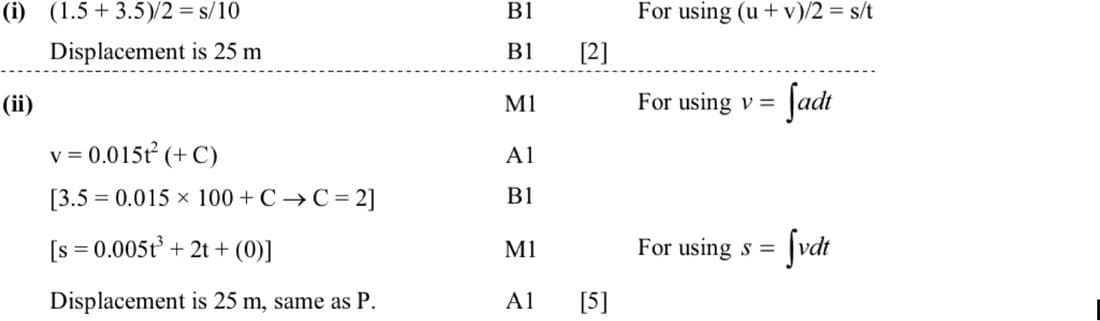
A particle P starts from a fixed point O at time t = 0, where t is in seconds, and moves with constant acceleration in a straight line. The initial velocity of P is 1.5 m s-1 and its velocity when t = 10 is 3.5 m s-1.
- Find the displacement of P from O when t = 10.
Another particle Q also starts from O when t = 0 and moves along the same straight line as P. The acceleration of Q at time t is 0.03t m s-2.
- Given that Q has the same velocity as P when t = 10, show that it also has the same displacement from O as P when t = 10.