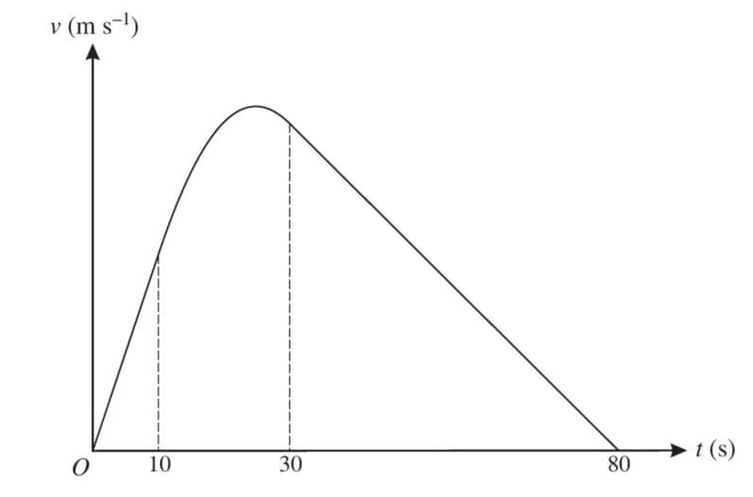
(i) To find the maximum velocity, we need to find the maximum point of the curve v = -0.01t2 + 0.5t - 1 for 10 ≤ t ≤ 30. Differentiate v with respect to t:
\(\frac{dv}{dt} = -0.02t + 0.5\)
Set \(\frac{dv}{dt} = 0\) to find the critical points:
\(-0.02t + 0.5 = 0\)
\(t = 25\)
Substitute \(t = 25\) back into the velocity equation:
\(v = -0.01(25)^2 + 0.5(25) - 1 = 5.25\)
Thus, the maximum velocity is 5.25 m s-1.
(ii) To find the distance AB, calculate the area under the velocity-time graph. The graph consists of three parts:
- From 0 to 10 s: A straight line with velocity increasing from 0 to 3 m s-1. The area is a triangle: \(s_1 = \frac{1}{2} \times 3 \times 10 = 15\) m.
- From 10 to 30 s: The curved section. Integrate the velocity function:
\(s_2 = \int_{10}^{30} (-0.01t^2 + 0.5t - 1) \, dt\)
\(s_2 = \left[ -0.01 \frac{t^3}{3} + 0.5 \frac{t^2}{2} - t \right]_{10}^{30}\)
\(s_2 = \left[ -0.01 \times \frac{30^3}{3} + 0.5 \times \frac{30^2}{2} - 30 \right] - \left[ -0.01 \times \frac{10^3}{3} + 0.5 \times \frac{10^2}{2} - 10 \right]\)
\(s_2 = ( -90 + 225 - 30 ) - ( -10/3 + 25 - 10 ) = 93.3\) m
- From 30 to 80 s: A straight line with velocity decreasing from 5 to 0 m s-1. The area is a triangle: \(s_3 = \frac{1}{2} \times 5 \times 50 = 125\) m.
Total distance \(AB = s_1 + s_2 + s_3 = 15 + 93.3 + 125 = 233.3\) m.