9709 P42 - Nov 2009 - Q7
3784
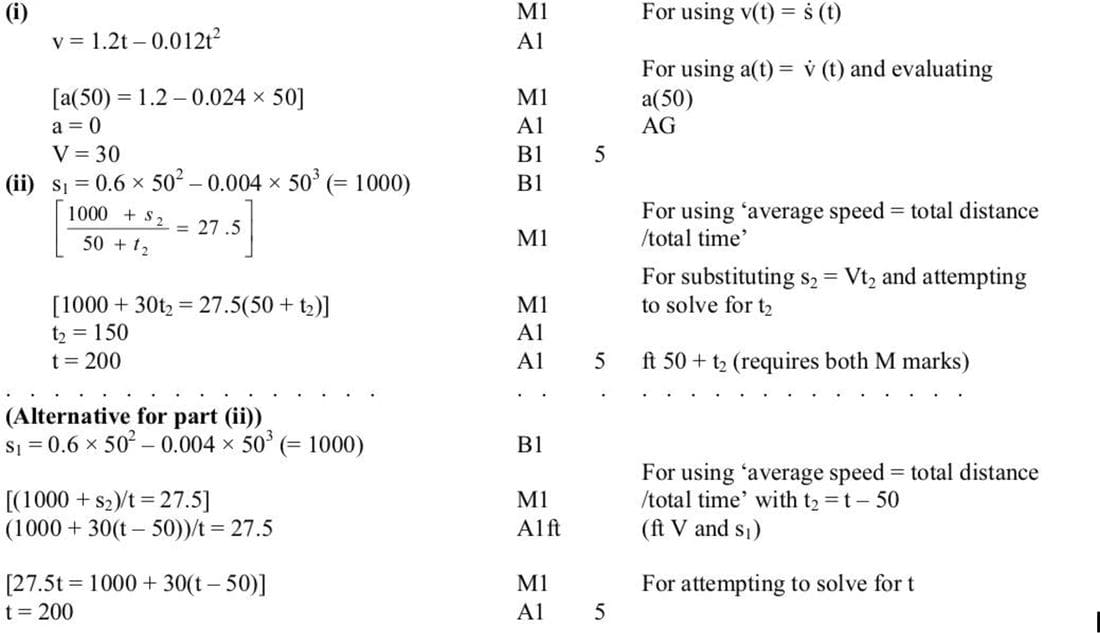
A motorcyclist starts from rest at A and travels in a straight line. For the first part of the motion, the motorcyclist’s displacement x metres from A after t seconds is given by x = 0.6t2 - 0.004t3.
- Show that the motorcyclist’s acceleration is zero when t = 50 and find the speed V m s-1 at this time.
- For t ≥ 50, the motorcyclist travels at constant speed V m s-1. Find the value of t for which the motorcyclist’s average speed is 27.5 m s-1.