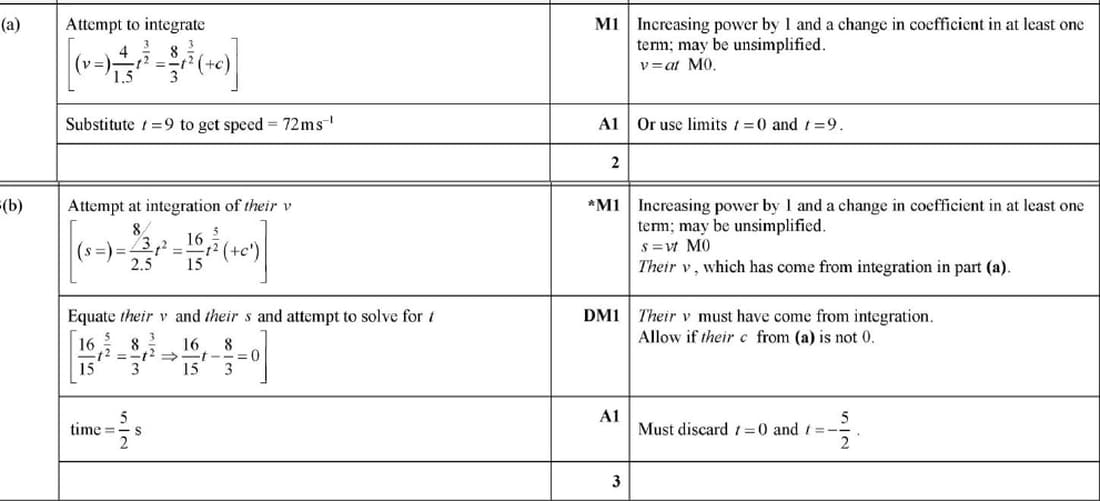
(a) To find the speed, integrate the acceleration function. The acceleration is given by \(a = 4t^{\frac{1}{2}}\). Integrating with respect to \(t\), we have:
\(v = \int 4t^{\frac{1}{2}} \, dt = \frac{4}{1.5} t^{\frac{3}{2}} + c = \frac{8}{3} t^{\frac{3}{2}} + c\)
Since the particle starts from rest, \(v = 0\) when \(t = 0\), so \(c = 0\).
Substitute \(t = 9\) to find the speed:
\(v = \frac{8}{3} (9)^{\frac{3}{2}} = 72 \text{ m/s}\)
(b) To find when the speed and distance are equal, first find the distance by integrating the speed function:
\(s = \int \frac{8}{3} t^{\frac{3}{2}} \, dt = \frac{8}{3} \cdot \frac{2}{5} t^{\frac{5}{2}} + c = \frac{16}{15} t^{\frac{5}{2}} + c\)
Since \(s = 0\) when \(t = 0\), \(c = 0\).
Set \(v = s\) to find \(t\):
\(\frac{8}{3} t^{\frac{3}{2}} = \frac{16}{15} t^{\frac{5}{2}}\)
\(\frac{8}{3} = \frac{16}{15} t\)
\(t = \frac{5}{2} \text{ s}\)