9709 P42 - Nov 2011 - Q7
3774
A tractor travels in a straight line from a point A to a point B. The velocity of the tractor is \(v \text{ m s}^{-1}\) at time \(t\) s after leaving A.
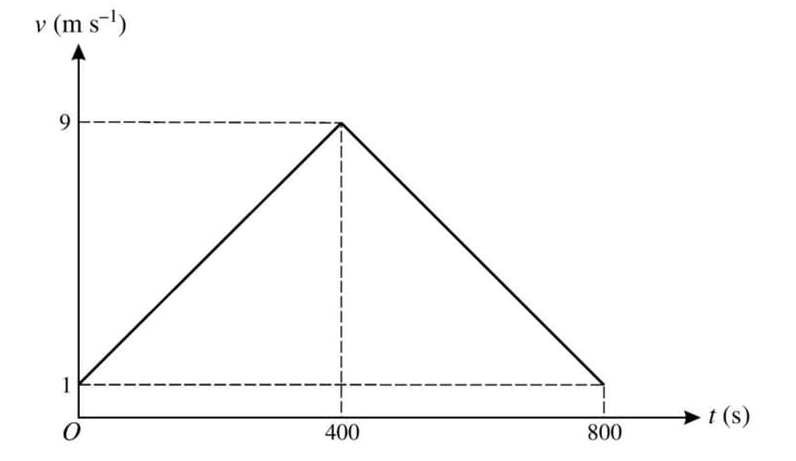
(i) The diagram shows an approximate velocity-time graph for the motion of the tractor. The graph consists of two straight line segments. Use the graph to find an approximation for
- the distance \(AB\),
- the acceleration of the tractor for \(0 < t < 400\) and for \(400 < t < 800\).
(ii) The actual velocity of the tractor is given by \(v = 0.04t - 0.00005t^2\) for \(0 \leq t \leq 800\).
- Find the values of \(t\) for which the actual acceleration of the tractor is given correctly by the approximate velocity-time graph in part (i).
For the interval \(0 \leq t \leq 400\), the approximate velocity of the tractor in part (i) is denoted by \(v_1 \text{ m s}^{-1}\).
- Express \(v_1\) in terms of \(t\) and hence show that \(v_1 - v = 0.00005(t - 200)^2 - 1\).
- Deduce that \(-1 \leq v_1 - v \leq 1\).
Solutions locked. Please sign in with access to view them.