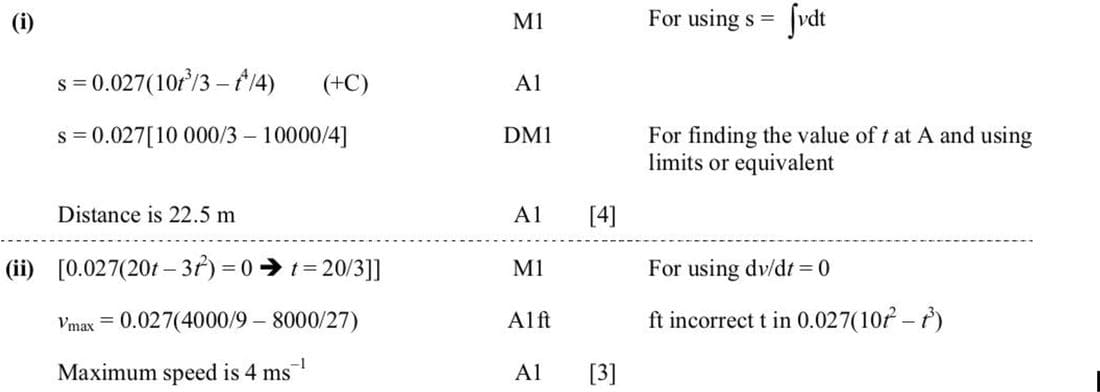
(i) To find the distance OA, we integrate the velocity function to find the displacement:
\(s = \int v \, dt = \int 0.027(10t^2 - t^3) \, dt\)
\(s = 0.027 \left( \frac{10t^3}{3} - \frac{t^4}{4} \right) + C\)
Since the particle starts from O, we set the constant of integration C to zero. At point A, the particle comes to rest, so we solve for t when v = 0:
\(0.027(10t^2 - t^3) = 0\)
\(t^2(10 - t) = 0\)
\(Thus, t = 10 s (ignoring t = 0 as it corresponds to the starting point).\)
\(Substitute t = 10 into the displacement equation:\)
\(s = 0.027 \left( \frac{10(10)^3}{3} - \frac{(10)^4}{4} \right)\)
\(s = 0.027 \left( \frac{10000}{3} - 2500 \right)\)
\(s = 0.027 \left( 3333.33 - 2500 \right)\)
\(s = 0.027 \times 833.33 = 22.5 \text{ m}\)
(ii) To find the maximum velocity, we differentiate the velocity function and set the derivative to zero:
\(\frac{dv}{dt} = 0.027(20t - 3t^2)\)
Set \(\frac{dv}{dt} = 0\):
\(0.027(20t - 3t^2) = 0\)
\(20t - 3t^2 = 0\)
\(t(20 - 3t) = 0\)
Thus, t = 0 or t = \(\frac{20}{3}\) s.
Substitute t = \(\frac{20}{3}\) into the velocity equation:
\(v_{\text{max}} = 0.027 \left( 10 \left( \frac{20}{3} \right)^2 - \left( \frac{20}{3} \right)^3 \right)\)
\(v_{\text{max}} = 0.027 \left( \frac{4000}{9} - \frac{8000}{27} \right)\)
\(v_{\text{max}} = 0.027 \times \frac{4000 - 2962.96}{9}\)
\(v_{\text{max}} = 0.027 \times 148.15 = 4 \text{ m s}^{-1}\)