Browsing as Guest. Progress, bookmarks and attempts are disabled.
Log in to track your work.
Nov 2014 p42 q7
3760
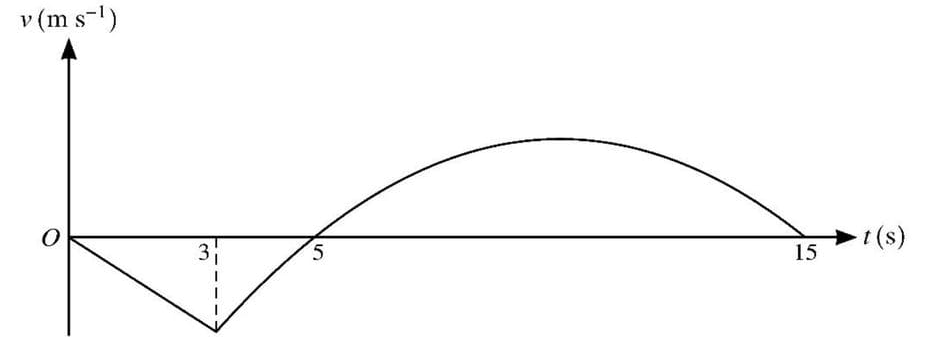
The diagram shows the velocity-time graph for the motion of a particle P which moves on a straight line BAC. It starts at A and travels to B taking 5 s. It then reverses direction and travels from B to C taking 10 s. For the first 3 s of P's motion its acceleration is constant. For the remaining 12 s the velocity of P is v m s-1 at time t s after leaving A, where
\(v = -0.2t^2 + 4t - 15\) for \(3 \leq t \leq 15\).
Find the value of v when t = 3 and the magnitude of the acceleration of P for the first 3 s of its motion.
Find the maximum velocity of P while it is moving from B to C.
Find the average speed of P,
while moving from A to B,
for the whole journey.
Solution
(i) For \(t = 3\), substitute into the velocity equation: \(v = -0.2(3)^2 + 4(3) - 15 = -4.8\) m s-1. The acceleration for the first 3 s is constant, using \(v = u + at\) with \(u = 0\), \(v = -4.8\), and \(t = 3\), gives \(a = \frac{-4.8}{3} = -1.6\) m s-2.
(ii) To find the maximum velocity, set \(\frac{dv}{dt} = 0\). Differentiate \(v = -0.2t^2 + 4t - 15\) to get \(\frac{dv}{dt} = -0.4t + 4\). Solve \(-0.4t + 4 = 0\) to find \(t = 10\). Substitute \(t = 10\) into the velocity equation: \(v = -0.2(10)^2 + 4(10) - 15 = 5\) m s-1.
(iii) (a) Distance from 0 to 3 s is \(\frac{1}{2} \times 3 \times 4.8 = 7.2\) m. From 3 to 5 s, integrate \(v = -0.2t^2 + 4t - 15\) from 3 to 5: \(\int_{3}^{5} (-0.2t^2 + 4t - 15) \, dt = 4.533\) m. Total distance = 7.2 + 4.533 = 11.733 m. Average speed = \(\frac{11.733}{5} = 2.35\) m s-1.
(b) For the whole journey, integrate from 3 to 15: \(\int_{3}^{15} (-0.2t^2 + 4t - 15) \, dt = 45.066\) m. Total distance = 7.2 + 45.066 = 52.266 m. Average speed = \(\frac{52.266}{15} = 3.00\) m s-1.