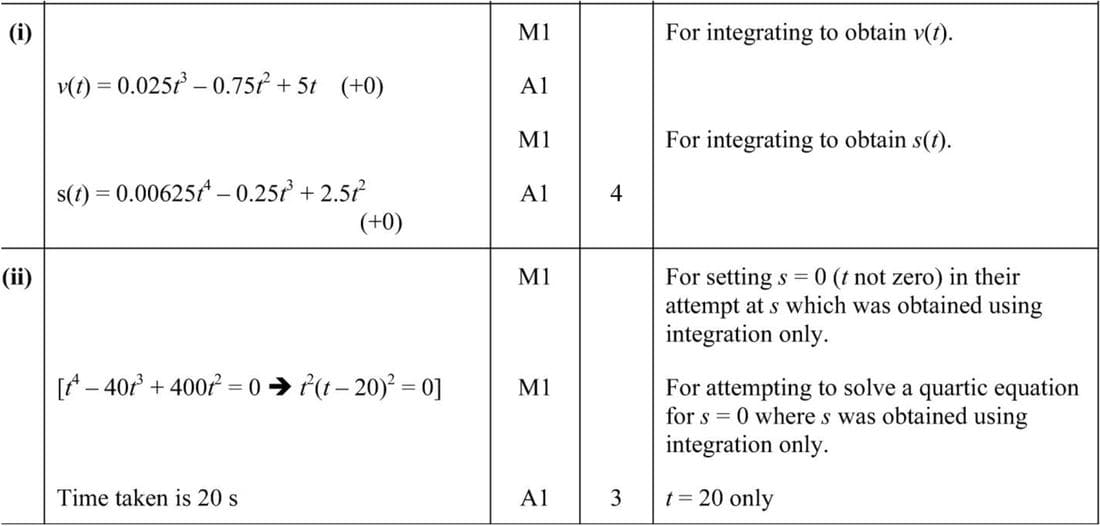
To find the displacement, we first integrate the acceleration to find the velocity. Given:
\(a(t) = 0.075t^2 - 1.5t + 5\)
Integrate \(a(t)\) to find \(v(t)\):
\(v(t) = \int (0.075t^2 - 1.5t + 5) \, dt = 0.025t^3 - 0.75t^2 + 5t + C\)
Since the particle starts from rest, \(v(0) = 0\), so \(C = 0\).
Thus, \(v(t) = 0.025t^3 - 0.75t^2 + 5t\).
Integrate \(v(t)\) to find \(s(t)\):
\(s(t) = \int (0.025t^3 - 0.75t^2 + 5t) \, dt = 0.00625t^4 - 0.25t^3 + 2.5t^2 + C\)
Since the displacement is zero at \(t = 0\), \(C = 0\).
Thus, \(s(t) = 0.00625t^4 - 0.25t^3 + 2.5t^2\).
To find when \(s(t) = 0\) again, solve:
\(0.00625t^4 - 0.25t^3 + 2.5t^2 = 0\)
Factor out \(t^2\):
\(t^2(0.00625t^2 - 0.25t + 2.5) = 0\)
\(t^2 = 0\) gives \(t = 0\), and solving \(0.00625t^2 - 0.25t + 2.5 = 0\) gives \(t = 20\).
Therefore, the time taken for P to return to the point O is 20 seconds.