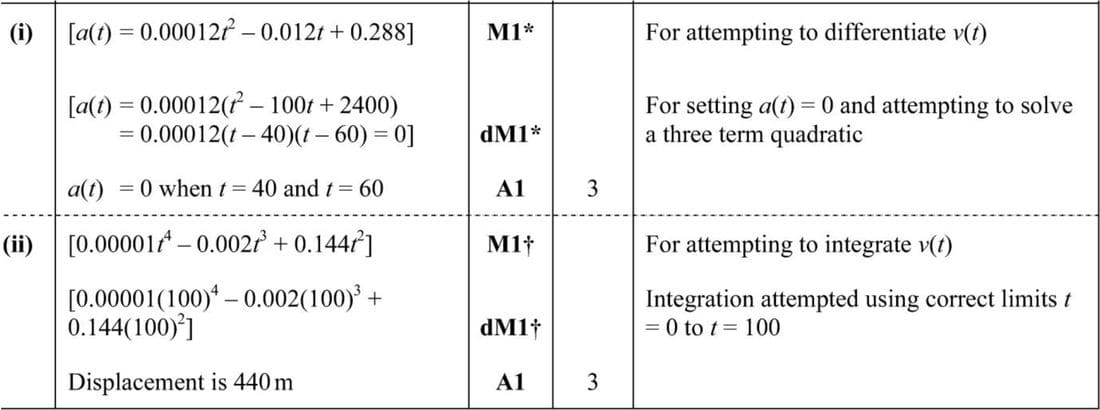
(i) To find the acceleration, differentiate the velocity function \(v(t) = 0.00004t^3 - 0.006t^2 + 0.288t\) with respect to \(t\):
\(a(t) = \frac{dv}{dt} = 0.00012t^2 - 0.012t + 0.288\).
Set \(a(t) = 0\) to find when the acceleration is zero:
\(0.00012t^2 - 0.012t + 0.288 = 0\).
Factor the quadratic equation:
\(0.00012(t^2 - 100t + 2400) = 0.00012(t - 40)(t - 60) = 0\).
Thus, \(t = 40\) and \(t = 60\).
(ii) To find the displacement, integrate the velocity function from \(t = 0\) to \(t = 100\):
\(\int_0^{100} (0.00004t^3 - 0.006t^2 + 0.288t) \, dt\).
Calculate the integral:
\(\left[ 0.00001t^4 - 0.002t^3 + 0.144t^2 \right]_0^{100}\).
Evaluate at the limits:
\(0.00001(100)^4 - 0.002(100)^3 + 0.144(100)^2 = 440\).
Therefore, the displacement is 440 m.