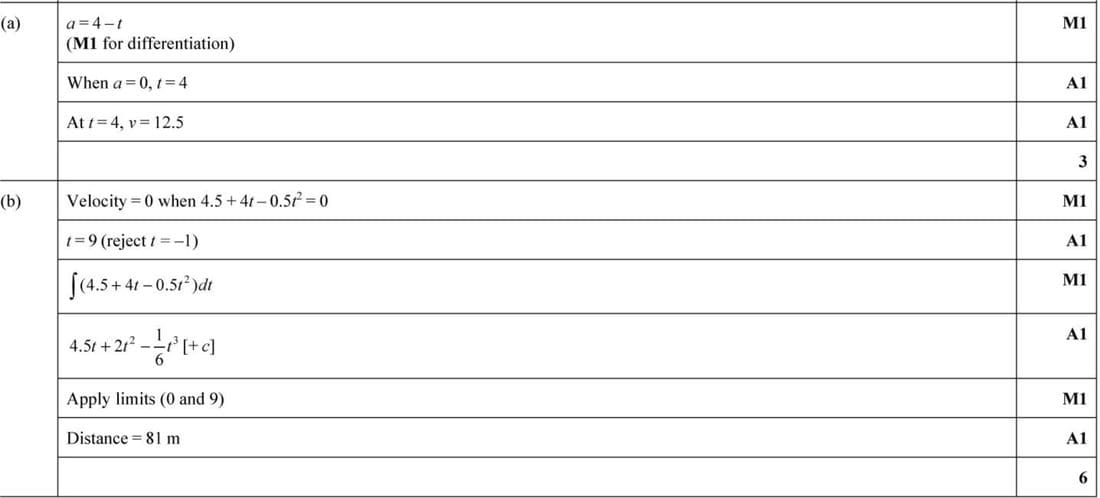
(a) To find the velocity when the acceleration is zero, first find the acceleration by differentiating the velocity function:
\(a = \frac{dv}{dt} = \frac{d}{dt}(4.5 + 4t - 0.5t^2) = 4 - t\).
Set the acceleration to zero:
\(4 - t = 0\).
Solving for \(t\), we get \(t = 4\).
Substitute \(t = 4\) into the velocity equation:
\(v = 4.5 + 4(4) - 0.5(4)^2 = 12.5\) m/s.
(b) The particle comes to rest when \(v = 0\):
\(4.5 + 4t - 0.5t^2 = 0\).
Solving the quadratic equation:
\(0.5t^2 - 4t - 4.5 = 0\).
Using the quadratic formula, \(t = 9\) (reject \(t = -1\)).
To find the distance \(PQ\), integrate the velocity function from \(t = 0\) to \(t = 9\):
\(\int (4.5 + 4t - 0.5t^2) \, dt = 4.5t + 2t^2 - \frac{1}{6}t^3 \bigg|_0^9\).
Calculate the definite integral:
\([4.5(9) + 2(9)^2 - \frac{1}{6}(9)^3] - [4.5(0) + 2(0)^2 - \frac{1}{6}(0)^3] = 81\) m.