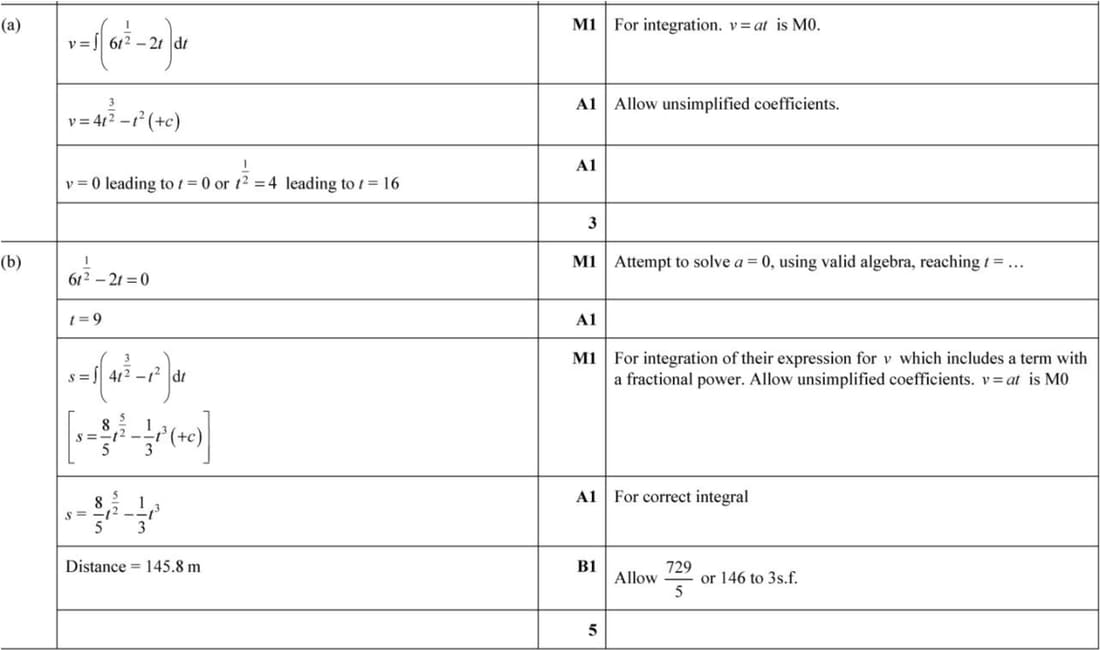
(a) To find the value of \(t\) at point B, we need to determine when the velocity \(v = 0\). The velocity is the integral of acceleration:
\(v = \int (6t^{\frac{1}{2}} - 2t) \, dt\)
\(v = 4t^{\frac{3}{2}} - t^2 + c\)
Since the particle starts from rest, \(v = 0\) when \(t = 0\), so \(c = 0\).
At point B, \(v = 0\):
\(4t^{\frac{3}{2}} - t^2 = 0\)
\(t^{\frac{1}{2}}(4t^{\frac{1}{2}} - t) = 0\)
\(t^{\frac{1}{2}} = 0 \text{ or } 4t^{\frac{1}{2}} = t\)
\(t = 0 \text{ or } t = 16\)
Thus, \(t = 16\) at point B.
(b) To find the distance travelled from A to the point where the acceleration is zero again, set \(a = 0\):
\(6t^{\frac{1}{2}} - 2t = 0\)
\(t^{\frac{1}{2}}(6 - 2t^{\frac{1}{2}}) = 0\)
\(t^{\frac{1}{2}} = 0 \text{ or } 6 = 2t^{\frac{1}{2}}\)
\(t = 0 \text{ or } t = 9\)
Integrate the velocity to find the distance \(s\):
\(s = \int (4t^{\frac{3}{2}} - t^2) \, dt\)
\(s = \left[ \frac{8}{5}t^{\frac{5}{2}} - \frac{1}{3}t^3 \right]\)
Evaluate from \(t = 0\) to \(t = 9\):
\(s = \frac{8}{5}(9)^{\frac{5}{2}} - \frac{1}{3}(9)^3\)
\(s = 145.8 \text{ m}\)