Browsing as Guest. Progress, bookmarks and attempts are disabled.
Log in to track your work.
Nov 2021 p41 q5
3501
A car of mass 1600 kg travels at constant speed 20 m s-1 up a straight road inclined at an angle of \(\sin^{-1} 0.12\) to the horizontal.
(a) Find the change in potential energy of the car in 30 s.
(b) Given that the total work done by the engine of the car in this time is 1960 kJ, find the constant force resisting the motion.
(c) Calculate, in kW, the power developed by the engine of the car.
(d) Given that this power is suddenly decreased by 15%, find the instantaneous deceleration of the car.
Solution
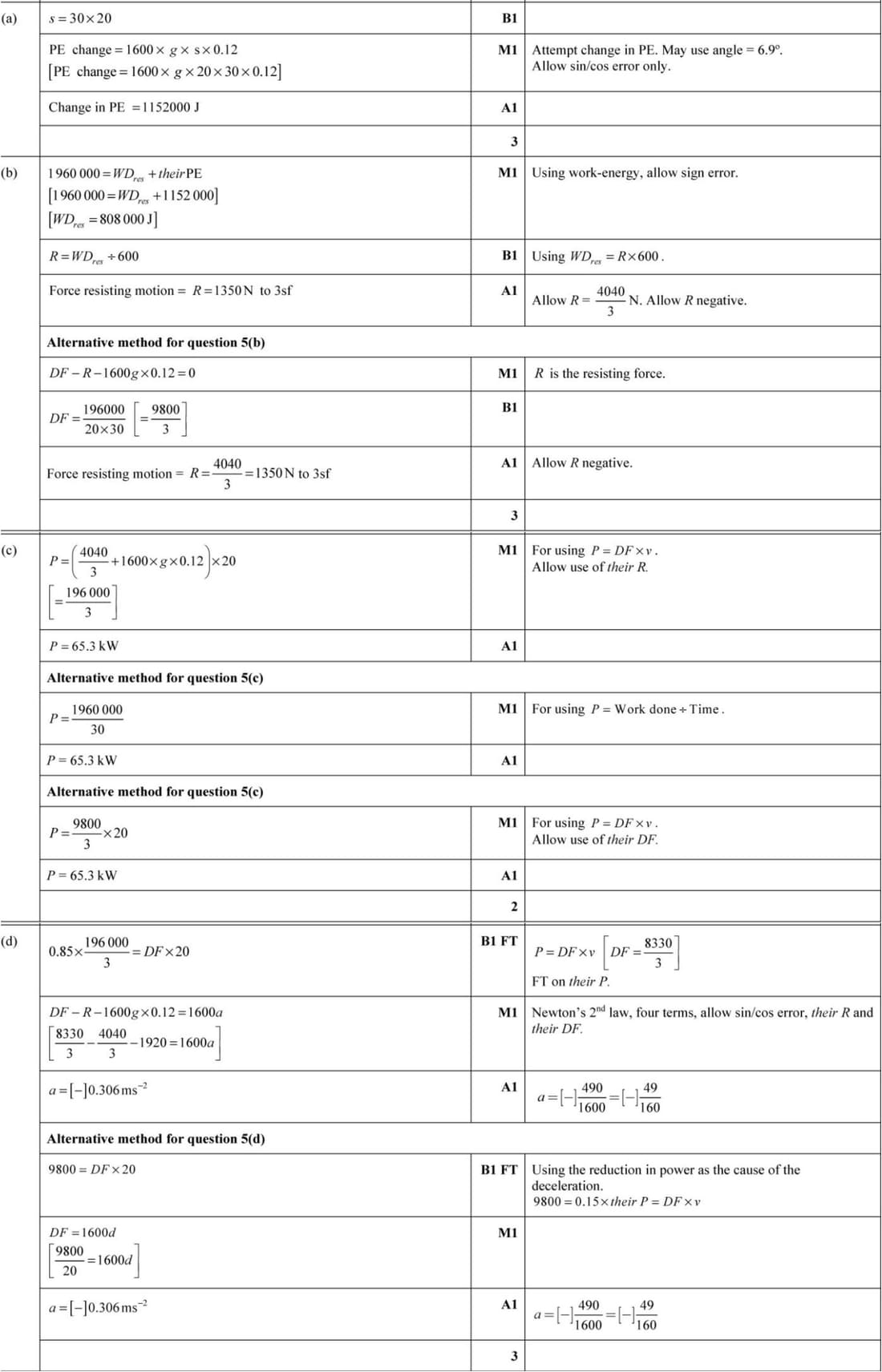
(a) The change in potential energy (PE) is given by \(\Delta PE = mgh\), where \(h = s \sin \theta\). Here, \(s = 30 \times 20 = 600 \text{ m}\) and \(\sin \theta = 0.12\). Thus, \(h = 600 \times 0.12 = 72 \text{ m}\).
(b) The total work done \(W = 1960 \times 1000 = 1960000 \text{ J}\). The work done against resistance \(W_D = W - \Delta PE = 1960000 - 1152000 = 808000 \text{ J}\).
The force resisting motion \(R = \frac{W_D}{s} = \frac{808000}{600} = 1350 \text{ N}\).
(c) The power developed \(P = \frac{W}{t} = \frac{1960000}{30} = 65333.33 \text{ W} = 65.3 \text{ kW}\).
(d) The new power is \(0.85 \times 65333.33 = 55533.33 \text{ W}\). Using \(P = Fv\), the driving force \(DF = \frac{55533.33}{20} = 2776.67 \text{ N}\).
Using Newton's second law, \(DF - R - mg \sin \theta = ma\).