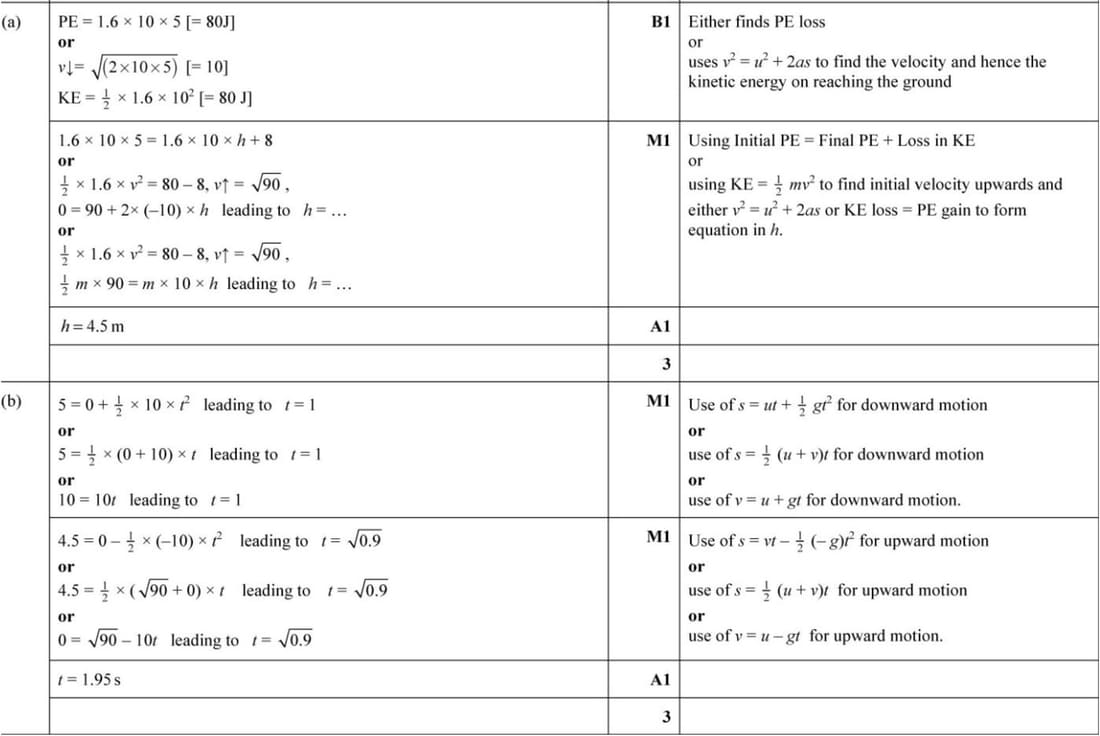
(a) The initial potential energy (PE) of the ball is given by:
\(\text{PE} = mgh = 1.6 \times 10 \times 5 = 80 \text{ J}\)
When the ball hits the ground, it loses 8 J of kinetic energy, so the kinetic energy (KE) just before hitting the ground is:
\(\text{KE} = 80 - 8 = 72 \text{ J}\)
Using the conservation of energy, the potential energy at the greatest height \(h\) after rebounding is equal to the kinetic energy just after the bounce:
\(mgh = 72\)
\(1.6 \times 10 \times h = 72\)
\(h = \frac{72}{16} = 4.5 \text{ m}\)
(b) For the downward motion, using the equation:
\(s = ut + \frac{1}{2}gt^2\)
\(5 = 0 + \frac{1}{2} \times 10 \times t^2\)
\(t^2 = 1\)
\(t = 1 \text{ s}\)
For the upward motion, using the equation:
\(s = vt - \frac{1}{2}gt^2\)
\(4.5 = 0 - \frac{1}{2} \times (-10) \times t^2\)
\(t^2 = 0.9\)
\(t = \sqrt{0.9} \approx 0.95 \text{ s}\)
Total time taken is:
\(1 + 0.95 = 1.95 \text{ s}\)